It seems odd to buy a high-permeability ferrite core and then deliberately cut a slot in its magnetic path. Yet the air gap in inductors that store energy is the feature that makes them work at all. Without it, a ferrite choke carrying direct current would saturate at a small fraction of its intended load, and its inductance would vary widely from batch to batch and across temperature.
This article explains what the gap does in magnetic terms, why most of the stored energy ends up in it, and what penalties it brings in the form of fringing flux and stray field. It also covers distributed-gap powder cores, which achieve the same result differently. The discussion reflects everyday practice at NG Electronics, where gapped ferrite assemblies and powder core toroids are wound and tested in-house.
Key takeaways
- A gap lowers effective permeability, trading inductance per turn for current capability.
- Most of the energy in a gapped inductor is stored in the gap, not in the ferrite.
- Gapping makes inductance more stable against material tolerance and temperature.
- Fringing flux near the gap heats nearby copper and radiates stray field.
What an air gap in inductors actually does
A magnetic circuit behaves much like an electrical one. The winding provides the driving force, equal to turns multiplied by current, and the core presents a reluctance that limits the flux. Ferrite has low reluctance, so a small current produces a large flux and the material soon reaches its saturation flux density. Air has a permeability several thousand times lower, so even a short gap adds a reluctance far greater than that of the whole ferrite path.
With the gap in place, much more current is needed to drive the same flux, and the core therefore saturates at a correspondingly higher current. The price is lower inductance for a given number of turns. Designers describe the outcome as an effective permeability, well below that of the ungapped material. Because inductance rises with turns squared while flux density rises only in proportion to turns, adding turns to a gapped core recovers the inductance and still leaves a higher saturation current.
Energy storage: why the gap holds the energy
The energy in an inductor is E = 1/2 L I², and physically it resides in the magnetic field. Energy density in a region equals half the flux density multiplied by the field strength. Flux density is nearly the same in the ferrite and in the gap, since the same flux crosses both, but the field strength in air is higher by the ratio of the permeabilities. The small volume of the gap therefore holds most of the energy.
This explains why energy-storage parts are always gapped while ordinary transformers are not. A forward or push-pull transformer transfers power directly and wants high magnetising inductance, so its core is left ungapped. A flyback transformer is really a coupled inductor that stores each cycle of energy before releasing it, so it needs a gap, as described in flyback transformer design basics. Buck, boost and power factor correction chokes fall in the same category.
Stability, tolerance and saturation behaviour
Ferrite permeability varies considerably between batches and changes with temperature and flux level. In an ungapped core, inductance follows those variations directly. Once a gap dominates the total reluctance, inductance depends mainly on the gap length and core dimensions, which are mechanical quantities that can be controlled closely. Gapped cores are therefore supplied with a much tighter inductance factor tolerance, and the value drifts far less across the operating temperature range.
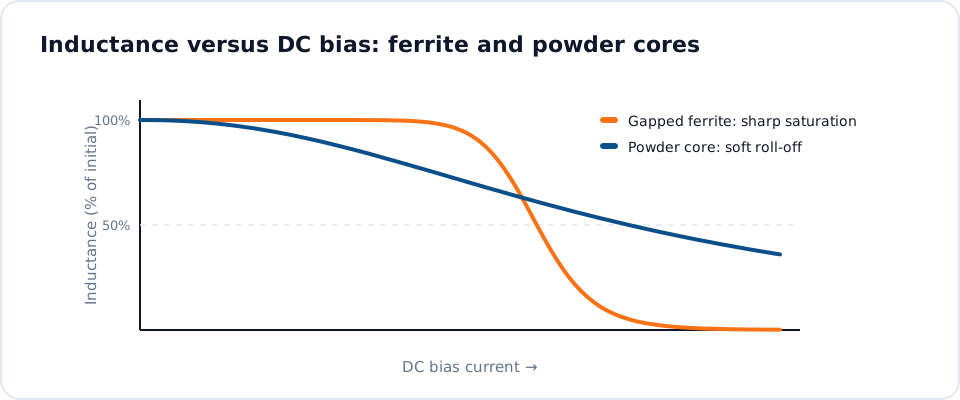
The gap does not raise the saturation flux density of the material; it only moves the current at which that density is reached. When a gapped ferrite finally saturates it does so abruptly, and inductance collapses over a narrow range of current. The peak current, including transients and the reduced saturation flux density at high temperature, must stay below that knee. The mechanism is examined further in transformer core saturation explained.
- Longer gap: higher saturation current, lower inductance per turn, more fringing.
- Shorter gap: higher inductance per turn, earlier saturation, greater material sensitivity.
- Gap length is typically chosen so that peak current sits safely below the knee.
Fringing flux and other side effects
Flux does not cross a gap in neat straight lines. It bulges outwards at the edges, and this fringing flux has two consequences. First, it enlarges the effective gap area, so measured inductance is somewhat higher than the simple calculation predicts. Second, the fringing field cuts through any copper nearby and induces eddy currents in it. Turns wound close to a large gap can develop local hot spots, particularly with thick solid wire or foil.
Good practice limits the damage. The gap is usually ground into the centre leg, where the winding and outer legs help to contain the field, instead of spacing all legs apart, which places gaps on the outside and radiates more. Windings can be kept a small distance away from the gap, and a long gap can be divided into several shorter ones. The suitability of each core family for gapping is compared in ferrite core shapes compared.
Discrete gap or distributed gap?
Powder cores take a different route. Iron powder, MPP, Sendust and High Flux materials consist of metal particles separated by thin insulation, so the gap is spread evenly through the whole core. There is no localised fringing, the stray field is low, and saturation is gradual: inductance declines progressively as current rises. The compromise is higher core loss than a gapped ferrite at high frequency and large ripple, so the choice depends on the waveform.
NG Electronics is an ISO 9001:2015 certified manufacturer in Pune, India, and builds both types: gapped ferrite core transformers and chokes on EE, ETD, PQ and RM cores, and powder core toroids as custom wound inductors. As a flyback transformer manufacturer and custom toroidal inductor manufacturer, we check inductance on every unit, which confirms the gap is correct. Buyers looking for an inductor manufacturer in Pune can request samples of either construction.
Frequently asked questions
Why do inductors need an air gap?
Inductors that carry direct current or store energy need a gap to prevent the core saturating at a low current. The gap increases the reluctance of the magnetic path, so more ampere-turns are required to reach saturation flux density. It also stores most of the energy and makes the inductance less sensitive to variations in the ferrite material.
Do toroidal inductors have an air gap?
Powder core toroids have a distributed gap formed by the insulation between metal particles, so no physical cut is needed. Ferrite toroids are normally ungapped and are used for common mode chokes and transformers where little net direct current flux exists. A ferrite toroid can be cut to add a gap, but that is uncommon for standard parts.
How is the gap length controlled in production?
The gap is typically ground into the centre leg of the ferrite to a specified inductance factor, or set with a non-magnetic spacer between core halves. Because inductance is highly sensitive to gap length, measuring inductance on each finished unit is an effective check. NG Electronics tests 100 percent of units for inductance and other electrical parameters.
About NG Electronics
NG Electronics is a leading ISO 9001:2015 certified manufacturer of toroidal power inductors, common mode chokes, ferrite core transformers, line filter inductors, drum core inductors and custom wound magnetic components, based in Pune, India. Every part is wound and 100% electrically tested in-house. Send your inductance, peak current and frequency to NG Electronics and we will recommend a gapped ferrite or powder core design, with a technical quotation within 24 working hours.