Custom magnetics vs catalogue parts is one of the first sourcing decisions on any power design, and it is frequently made by habit. Some teams reach for a distributor part number every time; others commission a bespoke component before checking whether a standard one would do. Both habits cost money. The sensible approach is to treat the choice as an engineering trade-off between fit, risk, lead time and total cost, and to make it position by position on the schematic.
This guide sets out when a standard inductor, choke or transformer is the right answer, when a custom design earns its place, and how to move between the two without redesigning the board. It is aimed at design engineers and purchase managers who share responsibility for the bill of materials, and it avoids rules that only hold for one topology or one power level.
Key takeaways
- Catalogue parts suit standard values, low volumes and early prototypes.
- Custom parts suit constrained size, loss, insulation or winding arrangements.
- Compare total cost over the product's life, not unit price alone.
- Measure the real operating conditions before specifying a custom replacement.
What a catalogue part gives you
A catalogue component arrives with a datasheet, a known footprint and, usually, immediate availability. For early prototypes that speed is valuable: the circuit can be proven before any winding specification exists. Standard parts also carry less commercial risk at low volumes, since nobody has to commit to a production batch. Families such as drum core inductors for DC-DC converters, standard toroidal power inductors and small common mode chokes cover a large share of everyday filter and converter positions.
The limitation is that the datasheet describes the conditions the manufacturer chose, not yours. Inductance is measured at a small signal level, saturation current is defined at a stated inductance drop, and rated current assumes a particular temperature rise in still air. If your frequency, ripple, ambient or mounting differs, the part may behave differently. Knowing how to read an inductor datasheet critically is the best protection against choosing a part that is nominally correct and practically marginal.
When custom magnetics are the better choice
A custom part is justified when the application asks for something the catalogue cannot combine. Typical triggers are a non-standard pairing of inductance and current, a mechanical envelope fixed by the enclosure, a required isolation voltage or creepage distance, a specified leakage inductance, multiple windings on one core, or a core material chosen for a particular frequency. Transformers are custom far more often than inductors, because turns ratios, auxiliary windings and insulation systems are specific to each power supply.
Custom design also removes compromise. A catalogue inductor is frequently larger than necessary because the nearest standard value has more margin than the circuit needs, or lossier because its core was selected for a different ripple level. A custom toroidal inductor manufacturer can choose the core size, material and wire gauge for your exact operating point, which typically improves either efficiency or volume, and sometimes both, once the part reaches production quantities.
Comparing cost, lead time and risk
Unit price is only one line in the comparison. A standard part has no engineering effort and no minimum batch, but its price is set by the distributor and it can be discontinued or go on allocation without notice. A custom part needs a specification, a sample cycle and a production minimum, yet its price at volume is often competitive because nothing is paid for unused margin. The honest comparison is total cost over the product's life, including the cost of a redesign if supply fails.
Lead time follows a similar pattern. Stock items can ship at once, while a custom sample needs days to design and wind. Once approved, however, a custom part is built to your schedule from raw materials the manufacturer controls. For risk, the question is who owns the design: with a custom part defined by your own drawing and test limits, a second manufacturer can build it; with a proprietary catalogue part, an equivalent has to be found and requalified.
- Choose catalogue when the value is standard, volumes are low and time matters most.
- Choose custom when size, loss, insulation or winding arrangement is constrained.
- Use a catalogue part to prove the circuit, then refine with a custom design.
- Record electrical test limits either way, so the part can be re-sourced.
Moving from a catalogue part to a custom design
A common and sensible route is to prototype with a standard component and then replace it. Before requesting a custom version, measure what the circuit really does: peak and RMS current, ripple amplitude, switching frequency range and the temperature the part reaches in the enclosure. Those measurements make a far better specification than the original datasheet values. An inductance calculator is useful for checking that the turns and core you have in mind are in the right region before discussing details.
Keep the footprint where possible, so the custom part drops onto the existing board. State which parameters are critical and which are flexible; a manufacturer can often offer a better result if allowed some freedom over core size or wire type. The prototype to production magnetics checklist lists the documents and approvals worth settling before the first batch, and a dedicated inductor prototype manufacturing service shortens the loop between a measurement and a revised sample.
Custom magnetics vs catalogue parts: a practical decision path
Start by asking whether a stock part meets the electrical need with honest margin at your operating conditions. If it does, and the volume is modest, use it. If it nearly does, ask what the shortfall costs in efficiency, size or test failures. If the position defines the product's performance, such as the main transformer, the PFC choke or the EMI filter, assume custom and confirm with a sample. Mixed bills of materials, with standard parts in ordinary positions and custom parts in critical ones, are normal.
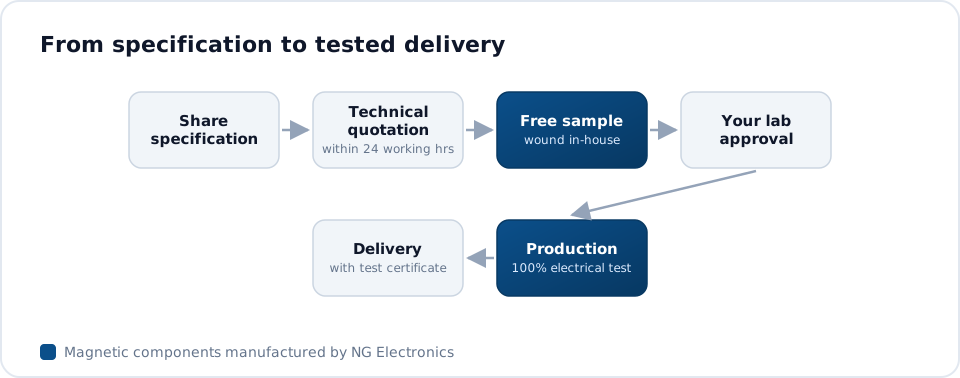
NG Electronics supports both routes. Its online catalogue lists stock parts, which typically dispatch within 24 hours, and it builds custom wound inductors in through-hole, SMD, chassis and flying-lead formats from prototypes to volume production. The company is an ISO 9001:2015 certified manufacturer in Pune, India, acting as an OEM inductor manufacturer for customers with their own drawings. MOQ is flexible, at about 10 pieces for R&D work, and overseas enquiries are welcome.
Frequently asked questions
Is a custom inductor always more expensive than a catalogue one?
No. A custom part carries a sample cycle and a production minimum, so it is rarely economical for a handful of pieces. At production quantities, though, the price is often comparable or lower, because the core and copper are sized for the real operating point. The comparison should include efficiency gains, board space and the cost of supply interruptions.
What minimum quantity applies to custom magnetics?
At NG Electronics, MOQ is flexible. Around 10 pieces is usual for R&D and prototyping, and single-piece prototype samples are possible for custom designs. Production MOQ for custom parts is typically 100 to 1,000 pieces, depending on the core and winding. Design support is free against firm production intent, and a free sample is supplied for laboratory approval.
Can a custom part replace a catalogue part without changing the PCB?
Usually, provided the footprint and height are stated as fixed constraints at the start. The manufacturer selects a core, base or lead arrangement to match the existing pads. Some electrical freedom helps, for example allowing a different core material, so that the replacement improves on the original instead of merely copying it. Always verify the sample in the real circuit.
About NG Electronics
NG Electronics is a leading ISO 9001:2015 certified manufacturer of toroidal power inductors, common mode chokes, ferrite core transformers, line filter inductors, drum core inductors and custom wound magnetic components, based in Pune, India. Every part is wound and 100% electrically tested in-house. Not sure whether a position needs a custom part? Send the specification or the catalogue part number to NG Electronics for a technical quotation and a sample.