Knowing how to choose a magnetics manufacturer matters more than most sourcing decisions on a power product, because inductors and transformers are rarely interchangeable commodities. Two parts with the same inductance can differ in core material, winding technique, insulation and test coverage, and those differences appear later as heat, noise or field failures. A supplier is therefore being selected for engineering judgement and process discipline as much as for price.
This guide gives design engineers and purchase managers a structured way to evaluate a supplier of wound components, wherever in the world that supplier is located. It covers technical capability, quality systems, testing, communication and commercial terms, and it suggests questions that reveal how a factory actually works. The same criteria apply whether you need a few prototype pieces or scheduled production.
Key takeaways
- Match the supplier's routine product families to the part you need.
- Treat the technical quotation as the first sample of the supplier's engineering.
- Ask what is tested on every unit, not only which certificate is held.
- Own the drawing and test limits so a second source remains possible.
How to choose a magnetics manufacturer: start with capability
Begin with fit. Ask which product families the factory builds routinely, which core materials and shapes it handles, and what current, inductance and power ranges it covers. A supplier that winds toroids every day will give better advice on a high-current choke than one that mainly assembles bobbin transformers, and the reverse holds too. Ask whether winding and testing are done in-house or subcontracted, since subcontracting lengthens the chain between your specification and the person holding the wire.
Look for evidence of range without overreach. A credible magnetic components manufacturer can state its limits plainly: the largest wire it can wind, the highest test voltage it can apply, the package formats it supports. Clear limits are a good sign, because they show the factory knows where its process is under control. Vague claims of being able to make anything usually mean the difficult work is passed to someone else.
Engineering support and the quality of the quotation
The quotation is the first real sample of a supplier's engineering. A useful technical quotation restates your requirement, proposes a core and winding, identifies anything ambiguous and lists the tests that will be performed. A price against a part number with no questions asked is a warning, particularly for a custom part. Good suppliers query missing information such as ripple current, ambient temperature or isolation voltage, because those gaps decide whether the part works.
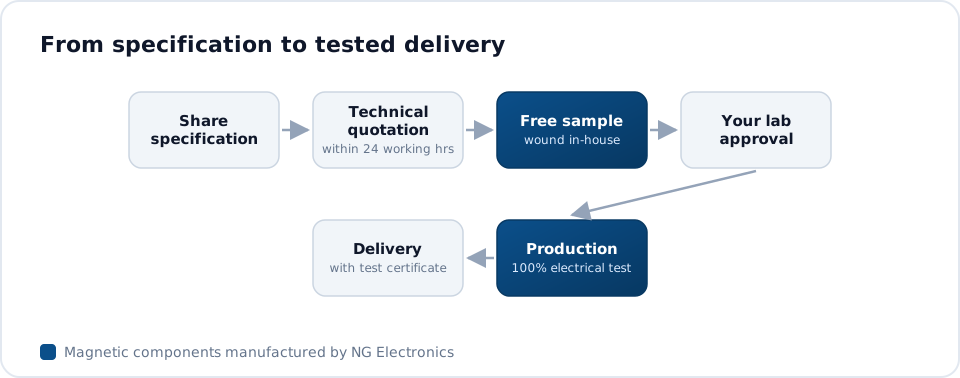
Ask how samples are handled. A defined loop of specification, quotation, sample, laboratory approval and production protects both parties, because the approved sample becomes the reference for every later batch. Speed matters as well: a supplier offering inductor prototype manufacturing with a short sample cycle lets you iterate while the rest of the design is still fluid. Check whether design assistance is charged separately or included when there is a genuine production requirement.
Quality system, testing and traceability
Certification to ISO 9001:2015 indicates a documented quality management system, which is a reasonable baseline. Beyond the certificate, ask what is measured, on how many units, and with what equipment. Sampling inspection and full electrical testing are very different commitments. For magnetics the relevant checks are inductance, DC resistance, Q factor, saturation current and hipot, with turns ratio and leakage inductance for transformers. The article on testing inductors and transformers explains what each test detects.
Traceability is the other half. If a problem appears in the field, you need to know which batch is affected and which raw materials went into it. Ask to see a batch record and a sample test certificate before placing an order. Material compliance belongs in the same conversation: the guide to RoHS and REACH for magnetic components describes the declarations a buyer should request. A supplier's quality assurance documentation should answer most of these points without prompting.
Commercial terms, flexibility and supply risk
Minimum order quantity, lead time and responsiveness shape the working relationship. A factory geared only to large runs may be unhelpful during development, while one that only makes prototypes may struggle when volumes rise. Ask for typical figures for both stages, and for the lead time of repeat orders once materials are established. Clarify packaging, labelling and documentation requirements early, especially for international shipments where customs paperwork and transit time add to the schedule.
No single supplier removes all risk. Ownership of the drawing and test specification allows a second source to be qualified if needed, as discussed in the article on dual sourcing magnetic components. A supplier comfortable working as an OEM inductor manufacturer to your documentation, and willing to record the agreed test limits, is making that future step easier. Reluctance to share construction details on a part you paid to develop deserves a direct question.
A shortlist of questions to ask
The questions below can be sent to any prospective supplier, and the manner of the reply is as informative as the content. Prompt, specific answers with figures and equipment names suggest a factory that understands its own process. NG Electronics, an ISO 9001:2015 certified manufacturer in Pune, India, answers them as follows: everything is wound and tested in-house, every unit is electrically tested, a technical quotation is typically issued within 24 working hours, and a free sample is provided for laboratory approval.
Team size and location matter less than clarity. NG Electronics was founded in 2017 and has a team of more than 50 people; it supplies customers across India from Pune, and overseas enquiries are welcome. Buyers who want to evaluate the company against the criteria in this guide can use the contact page to send a specification or request sample documentation. Whichever supplier you assess, weigh the answers to these questions above the headline unit price.
- Which cores, wire sizes and package formats do you handle in-house?
- Which electrical tests are performed on every unit, and with what equipment?
- What are the sample lead time and the minimum order quantity for prototypes and production?
- Can you supply batch traceability records and a test certificate with each delivery?
- Which material compliance declarations are available on request?
Frequently asked questions
What certifications should a magnetics manufacturer hold?
ISO 9001:2015 is the common baseline for a quality management system. Beyond that, the requirement depends on your market and product, so state any sector-specific approvals you need at the enquiry stage and ask for certificate copies. Material compliance declarations such as RoHS and REACH should also be available. A certificate does not replace evidence of actual test coverage on each batch.
How important is in-house winding and testing?
Very. When winding and testing happen under one roof, the people who interpret your specification also control the process and see the test results. Problems are found and corrected quickly, and traceability is simpler. Subcontracted work can be perfectly good, but it adds a link to the chain, so ask who performs each operation and where the records are kept.
How quickly should a supplier respond to an enquiry?
A capable supplier should acknowledge a clear specification and return a technical quotation within a few working days at most. NG Electronics typically issues a technical quotation within 24 working hours, and custom samples are typically ready within 7 to 10 working days. Slow or vague replies at the enquiry stage rarely improve once production begins.
About NG Electronics
NG Electronics is a leading ISO 9001:2015 certified manufacturer of toroidal power inductors, common mode chokes, ferrite core transformers, line filter inductors, drum core inductors and custom wound magnetic components, based in Pune, India. Every part is wound and 100% electrically tested in-house. Put these questions to NG Electronics: send your specification to sales@ngelectronics.in for a technical quotation and a sample for laboratory approval.