The nanocrystalline vs ferrite common mode choke question comes up whenever a filter must shrink, carry more current or survive a hotter enclosure. Both materials make effective chokes, and both are used in large volumes, but they differ in permeability, saturation flux density, frequency behaviour, temperature stability and cost. Choosing between them on a single headline number, such as initial permeability, tends to produce a part that looks good on paper and disappoints on the emission scan.
This comparison sets out how each material behaves in a real filter and where each one earns its place. NG Electronics, an ISO 9001:2015 certified manufacturer in Pune, India, winds common mode chokes on both high-permeability MnZn ferrite and nanocrystalline toroidal cores, from 250 mA up to 50 A, so the guidance here is drawn from building and testing both types and not from a preference for one.
Key takeaways
- Nanocrystalline cores typically offer several times the permeability of MnZn ferrite, so fewer turns are needed.
- Nanocrystalline saturates at roughly 1.2 T against about 0.4 to 0.5 T for MnZn ferrite.
- Ferrite is economical and available in many shapes, including compact UU cores.
- Compare impedance curves of complete wound parts, not material data alone.
What the two core materials are
MnZn ferrite is a ceramic made by pressing and sintering metal oxide powders. It can be moulded into toroids, UU, EE and many other shapes, which keeps tooling and core cost low, and its high resistivity gives low eddy current loss. Grades made for common mode chokes typically offer initial permeability from a few thousand up to around fifteen thousand. Our article comparing ferrite core shapes describes the available geometries and where each is used.
Nanocrystalline material is an iron-based alloy cast as a very thin ribbon, wound into a toroid and annealed so that it forms grains only nanometres across. The thin ribbon limits eddy currents, and the grain structure gives very high permeability, typically several times that of MnZn ferrite. Because the ribbon is brittle after annealing, cores are supplied in a plastic case or with an epoxy coating, and the practical shape is almost always a toroid.
Permeability, saturation and what they mean for size
Inductance is proportional to permeability and to the square of the turns. A core with several times the permeability therefore reaches the same inductance with noticeably fewer turns, or with a smaller core. Fewer turns bring three benefits: lower copper resistance and heating, room for thicker wire at high current, and lower capacitance between turns, which keeps the choke effective at higher frequencies. This is the main reason nanocrystalline parts are chosen for compact, high-current filters.
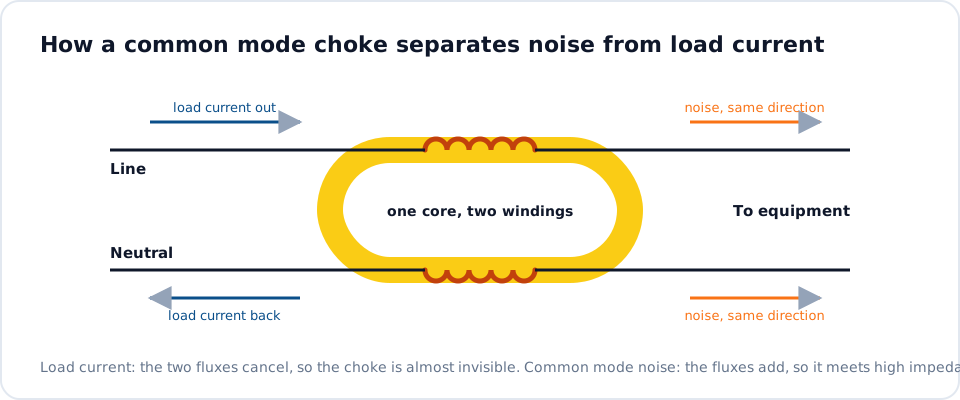
Saturation flux density differs as well. MnZn ferrite typically saturates at around 0.4 to 0.5 T at room temperature and lower when hot, while nanocrystalline alloys typically reach about 1.2 T. A common mode choke is not magnetised by balanced load current, but it is magnetised by common mode current and by any imbalance between the windings. In drives and inverters, where common mode current pulses are large, the extra headroom helps, as our article on EMI in motor drives and VFD systems explains.
Nanocrystalline vs ferrite common mode choke impedance across frequency
A choke is judged by its impedance across the band, not by inductance at one test frequency. The permeability of high-permeability MnZn ferrite begins to fall beyond a certain frequency, typically in the hundreds of kilohertz, and the fall begins earlier for higher-permeability grades. Above that point, impedance grows more slowly and eventually declines as winding capacitance takes over. Ferrite chokes can therefore show a fairly pronounced impedance peak, with less help on either side of it.
Nanocrystalline permeability also falls with frequency, but the material becomes progressively lossy, so its impedance stays broad and largely resistive over a wide range. Resistive impedance dissipates noise energy instead of storing it, which reduces the risk of the choke resonating with the Y capacitors. Always compare impedance curves measured on complete wound parts, since turns count and winding layout influence the result as much as the core itself.
Temperature stability, mechanical points and cost
Ferrite permeability varies noticeably with temperature, and high-permeability grades have a Curie temperature typically in the region of 120 to 150 °C, above which the core loses its magnetic properties until it cools. Nanocrystalline alloys have a Curie temperature of several hundred degrees and a much flatter permeability curve, so the practical limit is set by the case, coating and wire insulation. For hot enclosures this stability can decide the matter.
Cost runs the other way. Ferrite cores are inexpensive and available in shapes that suit bobbin winding, which makes compact UU-core PCB chokes economical for low currents. Nanocrystalline cores cost more per piece, although the saving in copper and volume can offset this at high current. One caution applies: very high permeability means a small imbalance or direct current can drive the core towards saturation, so the working conditions should be shared with the choke supplier.
Which one to choose
Neither material is the better choice in general; the application decides. Ferrite remains the sensible default where space and temperature are moderate, and nanocrystalline justifies its price where one of those limits is tight. As a starting point, the following pattern holds for most designs, and the common mode choke selection checklist lists the parameters to confirm with measurements before an order is placed.
NG Electronics supplies both types as standard ring-core parts and builds custom versions through its custom wound inductor and custom toroidal winding services. For filters above about 10 A, the high-current common mode choke page describes typical constructions. If you are unsure, request one sample of each for the same footprint and compare them on the emission scan; the EMI filter choke team can match inductance and current rating so the comparison is fair.
- MnZn ferrite: low to medium current, cost-sensitive products, PCB-mount UU or small toroidal formats, moderate ambient temperature.
- Nanocrystalline: high current, restricted volume, high ambient temperature, or a need for broad impedance from the low conducted band upward.
- Either: mid-range mains filters, where a sample comparison on the actual product settles the question.
Frequently asked questions
Is a nanocrystalline choke always smaller than a ferrite one?
Usually, for the same inductance and current, because higher permeability means fewer turns or a smaller core. The advantage is greatest at high current, where copper volume dominates the part. At low current, a ferrite UU-core choke on a bobbin can be just as compact and costs less, so the size benefit should be confirmed against an actual footprint drawing.
Can I replace a ferrite choke with a nanocrystalline one of the same inductance?
Often, but check more than inductance. The impedance curve, leakage inductance, winding capacitance and tolerance to unbalanced current will all differ, so the differential mode attenuation and the high-frequency behaviour of the filter may change. Repeat the conducted emission scan after the swap, and confirm temperature rise at full load before releasing the change to production.
Does NG Electronics test both core types in the same way?
Yes. Every choke, whatever the core material, is electrically tested before dispatch, covering inductance, DC resistance and hipot, and batch records give traceability to raw material and production date. A test certificate can be supplied with the order on request, and RoHS and REACH compliant materials are used, with certificate copies available on request.
About NG Electronics
NG Electronics is a leading ISO 9001:2015 certified manufacturer of toroidal power inductors, common mode chokes, ferrite core transformers, line filter inductors, drum core inductors and custom wound magnetic components, based in Pune, India. Every part is wound and 100% electrically tested in-house. Tell NG Electronics your line current, target inductance and available footprint at sales@ngelectronics.in, and ask for ferrite and nanocrystalline samples to compare. Overseas enquiries are welcome.