
Switch-mode power supplies
Single-stage and two-stage mains input filters for adaptors, open-frame supplies and LED drivers, usually with a compact PCB-mount common mode choke ahead of the bridge rectifier.
Enquire now


NG Electronics · ISO 9001:2015 Certified Company
NG Electronics is an ISO 9001:2015 certified EMI filter choke manufacturer in Pune, winding common mode and differential mode chokes from 250 mA to 50 A for mains and DC input filters.
Every switching converter pushes high-frequency noise back down its supply leads, and a product that fails the conducted emissions scan cannot be shipped. As an EMI filter choke manufacturer, NG Electronics winds the magnetic parts of that filter in-house in Pune: common mode chokes from 1 mH to 100 mH and differential mode line chokes from 100 µH to 10 mH.
Conducted noise comes in two forms. Differential-mode noise flows out on one line and returns on the other, driven mainly by the switching ripple current. Common-mode noise flows in the same direction on both lines and returns through earth, coupled by parasitic capacitance from switching nodes to the chassis or heatsink. The two need different components, so a filter that deals with only one of them usually fails at one end of the spectrum.
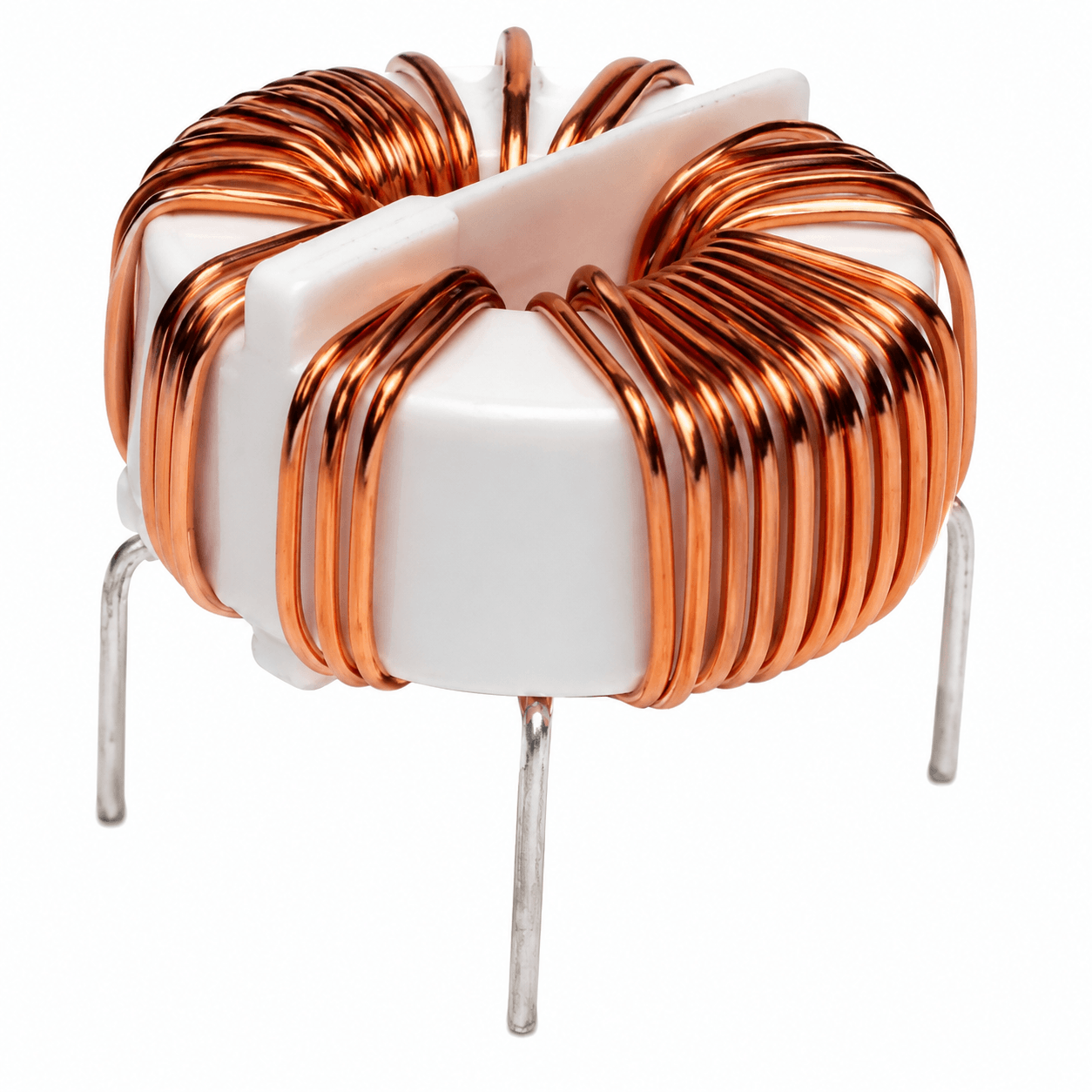
A common mode choke carries both line conductors on one core, wound so that the flux from the load current cancels. The core therefore sees almost none of the load current and can use high-permeability MnZn ferrite or nanocrystalline material to give a large inductance in a small volume. A differential-mode choke has no such cancellation, so it needs a core that tolerates the full line current without saturating, typically iron powder or a gapped ferrite.
 ISO 9001:2015 certified
These are the ranges we build as a common mode choke manufacturer in India. Values outside them, or parameters that depend on your circuit, are fixed during the design discussion.
| Common mode inductance | 1 mH to 100 mH |
|---|---|
| Common mode current rating | 250 mA (UU-core PCB chokes) to 50 A (ring-core chokes) |
| Differential mode inductance | 100 µH to 10 mH |
| Differential mode current rating | 500 mA to about 50 A |
| Core materials | High-permeability MnZn ferrite and nanocrystalline toroids; toroidal, EE and UU cores for line chokes |
| Winding options | Sectional, bifilar and split winding |
| Testing | 100% electrical test: inductance, DCR, Q factor, saturation current, hipot |
| Compliance | RoHS and REACH compliant materials; certificate copies available on request |
Emission compliance is assessed on the finished product.
Any equipment with a switching stage and a cable to the outside world needs input filtering.
Single-stage and two-stage mains input filters for adaptors, open-frame supplies and LED drivers, usually with a compact PCB-mount common mode choke ahead of the bridge rectifier.
Enquire now
Chokes on both the DC input and the AC output of the inverter, where long cable runs and large panel capacitance to earth make common-mode current a recurring problem.
Enquire now
Higher-current ring-core chokes for charger input stages, including three-phase versions, sized for continuous duty rather than short bursts.
Enquire now
Filters for motor drives, PLC power supplies and control panels, where noise from one unit must not disturb sensors and communication lines sharing the same cabinet.
Enquire nowStock parts you can order today. View details, add to cart or enquire for a custom variant.


Share the scan, the line voltage and the rated current with sales@ngelectronics.in or on +91 83290 52861. We reply with a technical quotation within 24 working hours.
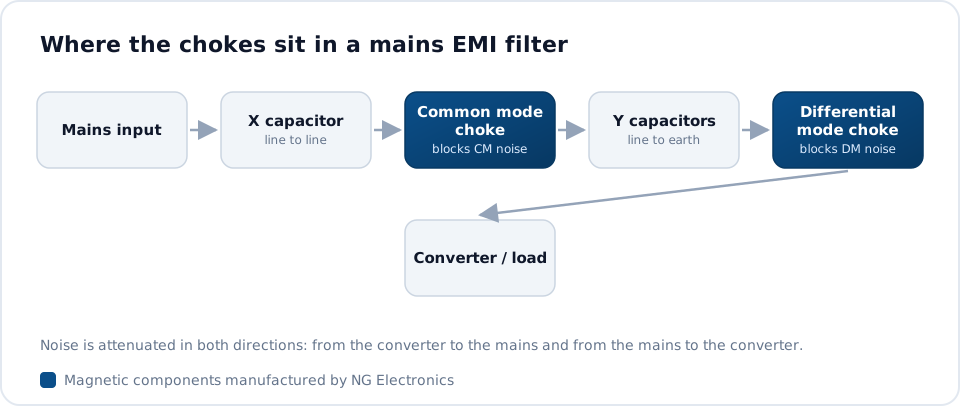
The usual filter places X capacitors across the lines and Y capacitors from each line to earth, with chokes between them. The X capacitor and the differential inductance form a low-pass stage for differential-mode noise; the Y capacitors and the common mode choke do the same for common-mode noise. Because Y capacitance is limited by the permitted earth leakage current, most of the common-mode attenuation has to come from the choke, which is why its inductance runs to millihenries.
Limits in CISPR 32 for multimedia equipment and CISPR 14 for household appliances and tools apply across the conducted band, typically measured from 150 kHz to 30 MHz through a line impedance stabilisation network. A choke chosen by inductance alone can pass at low frequency and fail higher up, because inter-winding capacitance sets a self-resonant frequency beyond which impedance falls.


The filter choke is often the last part chosen and the first blamed when a scan fails, so it helps to buy from the people who wind it. NG Electronics is an ISO 9001:2015 certified manufacturer founded in 2017, with a team of more than 50 in Pune. Winding and testing happen under one roof, on semi-automatic toroidal and linear winding machines, and batch records trace each lot back to its raw material and production date.
For buyers looking for an EMI filter inductor supplier in India, the practical advantages are short loops and small batches. A technical quotation follows within 24 working hours of a complete specification, a free sample is supplied for approval in your lab, and custom samples typically take 7 to 10 working days. If the first sample leaves a few decibels of margin to find, the turns or core can be revised and a new sample wound.
Call, WhatsApp or use the form with inductance, current and quantity.
Price, lead time and datasheet within 24 working hours.
Sample built in-house for your lab testing and approval.
Production with 100% electrical testing under ISO 9001:2015.
Packed with a test certificate, shipped across India or exported worldwide.
Answers about EMI filter choke manufacturer from NG Electronics, an ISO 9001:2015 certified company
The essentials are line voltage and frequency, rated and peak current, number of phases, the inductance or impedance you are aiming for, and the space and mounting available on the board. A conducted emissions plot of the unfiltered product is very useful if you have one. With that information NG Electronics returns a technical quotation within 24 working hours.
Differential-mode noise circulates between line and neutral, in opposite directions on the two conductors, and is tied to the converter's ripple current. Common-mode noise travels the same way on both conductors and returns through earth via stray capacitance. A common mode choke blocks the second kind while passing load current freely; differential-mode noise needs series inductance and X capacitance instead.
X capacitors sit across the lines and shunt differential-mode noise. Y capacitors connect each line to earth and give common-mode noise a short return path back to its source. A choke raises the series impedance so the capacitors can do their work. Y capacitor values are kept small to limit earth leakage current, so the common mode choke carries most of that burden.
No component can guarantee that on its own. CISPR 32 and CISPR 14 limits apply to the complete product, and the result depends on the capacitors, PCB layout, earthing and cabling as well as the choke. What we do is build the choke to an agreed inductance, current and impedance target and supply samples so you can confirm the result in your own scan.
Usually, yes. If you send the pin pitch, the height limit and the electrical target, we check whether a core that fits can carry the current without excessive temperature rise. Where the footprint is too small for the required inductance, we say so and suggest the nearest workable option.
Minimum quantities are flexible. Around 10 pieces is normal for R&D and prototyping, single-piece prototype samples are possible for custom designs, and production batches of custom parts typically start between 100 and 1,000 pieces. Stock items typically dispatch within 24 hours, and custom samples typically take 7 to 10 working days from an agreed specification.

EMI suppression chokes from 250 mA to 50 A.
Learn moreHigh current common mode choke up to 50 A from an ISO 9001:2015 certified maker in Pune
Learn more
Common mode choke for SMPS input filters, from 250 mA UU-core PCB parts upward
Learn more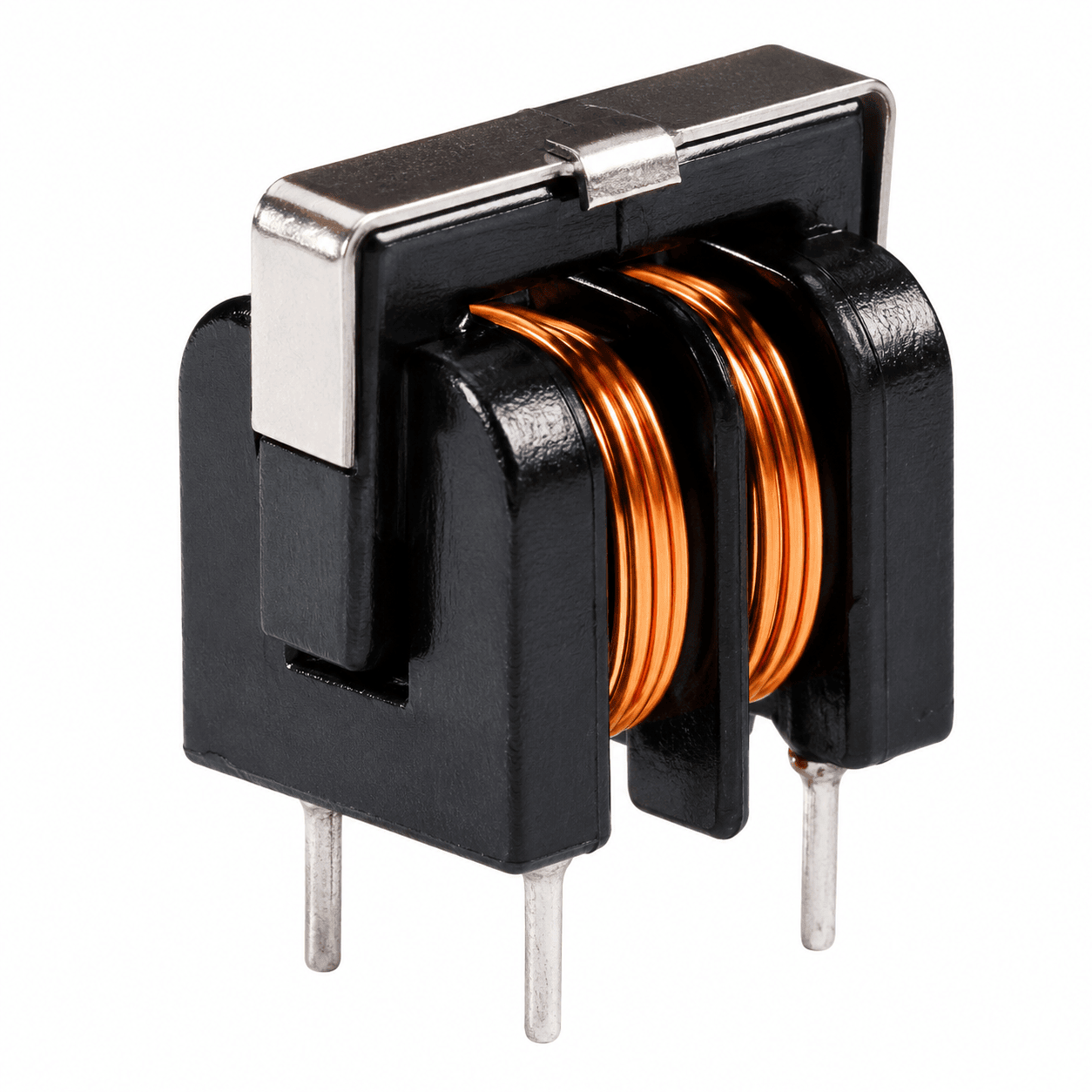
AC line filter choke manufacturer in Pune, ISO 9001:2015 certified
Learn moreSend your specification or drawing for EMI filter choke manufacturer. NG Electronics is an ISO 9001:2015 certified company, and every enquiry is answered by our engineering and sales team in Pune.



These products are limited, checkout within

Smart configuration workspace setup.


