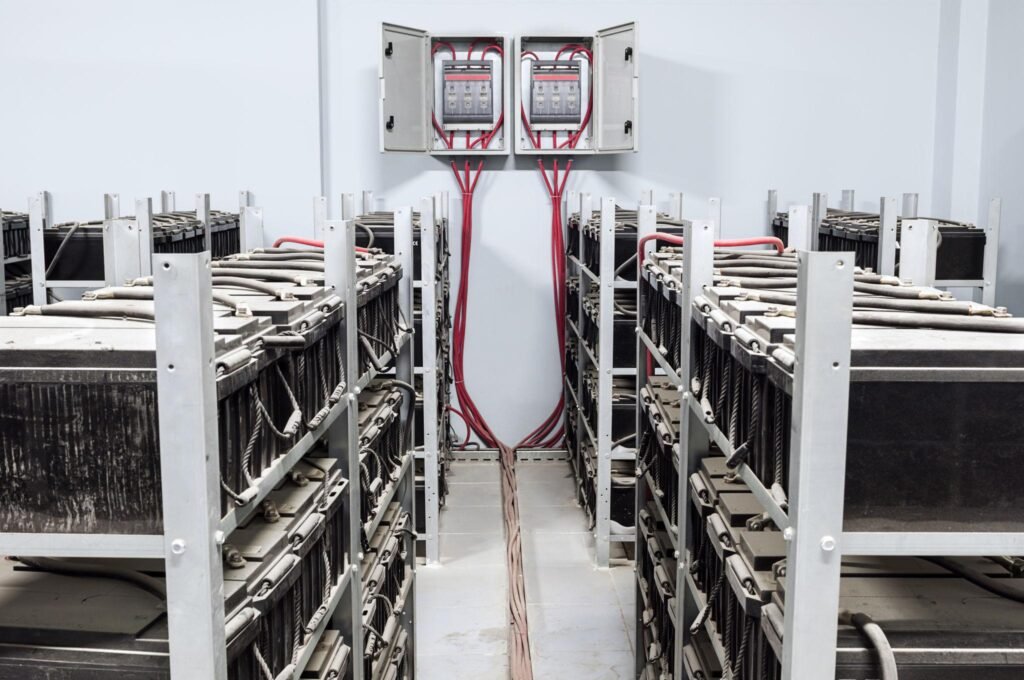
An uninterruptible power supply has one task: to keep the load running when the mains does not. Behind that simple promise sit several power conversion stages, and each relies on wound components. Magnetics for UPS equipment include the input line chokes and EMI filters, the inductors of the rectifier and battery converter, the inverter output filter and, in some designs, an isolation transformer. The same building blocks appear in stationary energy storage converters.
This article describes those parts stage by stage for online double-conversion and line-interactive designs, and notes how energy storage systems differ. NG Electronics is an ISO 9001:2015 certified manufacturer based in Pune, India, with inductors, chokes and transformers wound and tested in-house on its own winding and test equipment. Overseas enquiries are welcome, and documentation and test certificates are available on request.
Key takeaways
- A double-conversion UPS has magnetics in the input filter, rectifier, battery converter and inverter output.
- Battery converter inductors see their highest current at the lowest battery voltage.
- Output inductors must stay unsaturated at the peak current of high crest factor loads.
- Hot-spot temperature at continuous load governs insulation life.
Where magnetics for UPS systems are used
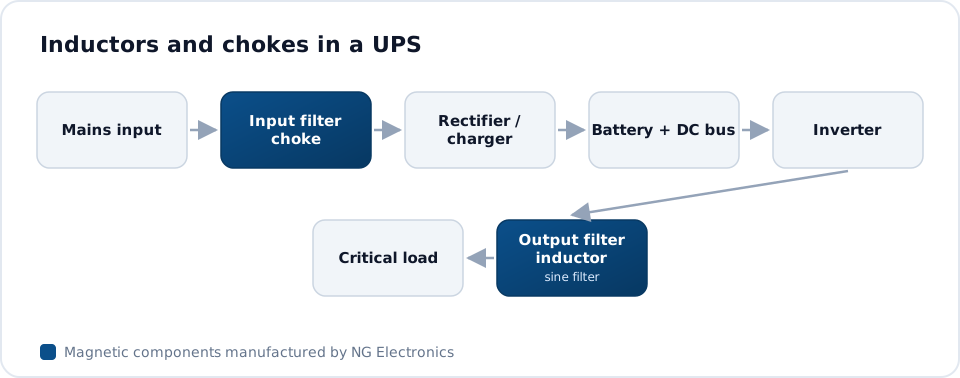
In an online double-conversion UPS the load is always fed from the inverter. Mains power passes through an input filter and a rectifier with power factor correction to a DC bus, a battery converter charges and discharges the battery from that bus, and the inverter rebuilds a regulated sine wave. A static bypass routes mains directly to the load if the inverter is overloaded or faulty. Line-interactive units are simpler, using a single bidirectional converter and often an automatic voltage regulating transformer.
Each block contains at least one significant inductor. Their ratings scale with the power of the unit, from a few amperes in desktop models to hundreds of amperes in large installations, yet the design questions are the same at every size: how much inductance is needed, at what current must it be maintained, how much loss is acceptable, and how will the heat leave the enclosure.
Input chokes, line reactors and EMI filters
The input stage must limit harmonic currents drawn from the supply and stop switching noise from leaving the cabinet. Smaller units use an active PFC boost inductor; larger three-phase units use an active front end with one inductor per phase, or a rectifier with line reactors that add impedance and soften current peaks. The NG Electronics range of line filter inductors covers 500 mA to about 50 A and includes line reactors for three-phase panels.
Conducted emissions are handled by common mode chokes working with X and Y capacitors, usually on both the input and the output because either cable can radiate. Sectional winding keeps the two windings apart for insulation and deliberately leaves a little leakage inductance, which helps with differential mode noise. Suitable common mode chokes are available from 250 mA to 50 A, and construction options are listed on the AC line filter choke page.
Battery converter inductors
Between the battery and the DC bus sits a converter that acts as a charger in one direction and as a boost stage in the other. Its inductor carries a large direct current with ripple superimposed, and during discharge at low battery voltage the current is at its highest just when the unit is under the most stress. The energy stored, E = 1/2 L I^2, rises with the square of current, which is why core size grows quickly with rating.
Powder cores with a distributed gap are the typical choice because they tolerate overload without sudden loss of inductance. Ripple on the battery side should be kept moderate, since battery manufacturers typically limit the alternating current their cells should carry. Larger energy storage installations use the same principles at higher power, and the details are covered in inductors for battery energy storage systems and on the inductors for UPS systems page.
Inverter output filter
The inverter bridge produces a pulse-width-modulated waveform that an LC filter converts into a low-distortion sine wave. Unlike a grid-tied inverter, a UPS must hold its output voltage with non-linear loads such as computer power supplies, which draw current with a high crest factor. The output inductor therefore has to stay out of saturation at peaks well above the RMS rating, and its impedance at mains frequency must be low enough to keep voltage regulation tight.
Core loss comes from the switching-frequency ripple, while copper loss comes mainly from the fundamental current, so the two can be optimised separately. Toroidal powder cores are common up to moderate currents, and the high-current toroidal inductor page shows how heavier gauge and multi-strand copper extend the range. Sizing rules for the filter itself are explained in output filter inductors for inverters.
Reliability, testing and supply
A UPS spends most of its life at partial load in a warm room and is then expected to deliver full power instantly. Magnetics are rarely the first part to wear out, but insulation ages faster at higher temperature, so the hot-spot temperature at continuous load deserves attention. Mechanical details matter too: large cores can produce audible noise at ripple frequency, and heavy parts need secure mounting to survive transport.
Standard toroidal power inductors cover 10 µH to 10 mH at up to 25 A, and custom designs are built for higher currents. Every unit is tested for inductance, DCR, saturation current and hipot, and batch records give traceability to raw material and production date. The OEM inductor manufacturing page explains how NG Electronics supports repeat production once a sample is approved.
- State inductance at zero current and at the peak of the worst-case load
- Give battery voltage range and the maximum discharge current
- Specify ambient temperature, airflow and permitted temperature rise
- Define mounting, terminations and any acoustic noise limit
Frequently asked questions
Which inductors are used in an online UPS?
An online UPS typically contains a PFC or front-end inductor for each input phase, a battery converter inductor, an inverter output filter inductor and common mode chokes at the input and output. Larger units may add line reactors and an isolation transformer. Small flyback transformers power the control and monitoring circuits.
Why must a UPS output inductor handle a high peak current?
Computer and rectifier loads draw current in narrow pulses, so the peak can be several times the RMS value. If the inductor saturates at those peaks, its inductance collapses, ripple current rises sharply and output voltage distortion increases. The inductance should therefore be specified at the expected peak current, not only at the rated RMS current.
Do energy storage converters use the same magnetics as a UPS?
Broadly, yes. Both use a bidirectional battery converter inductor, an inverter filter and EMI chokes. Storage converters generally run at sustained high power in both directions and connect to the grid, so an LCL filter is more common and thermal design is based on continuous cycling rather than occasional discharge.
About NG Electronics
NG Electronics is a leading ISO 9001:2015 certified manufacturer of toroidal power inductors, common mode chokes, ferrite core transformers, line filter inductors, drum core inductors and custom wound magnetic components, based in Pune, India. Every part is wound and 100% electrically tested in-house. Send your UPS or storage converter magnetics specification to NG Electronics at sales@ngelectronics.in for a technical quotation, typically within 24 working hours, and a sample for lab approval.