
Solar inverters
Boost and output filter inductors carry a large DC or line-frequency current with switching ripple on top. Inductance held at peak current decides how well that ripple is controlled.
Enquire now


NG Electronics · ISO 9001:2015 Certified Company
NG Electronics is an ISO 9001:2015 certified high current toroidal inductor manufacturer in Pune. Standard parts carry up to 25 A; heavier gauge and multi-strand windings take custom designs higher.
A high current inductor is judged by what it does under load, not by the figure on the LCR meter at zero bias. As a high current toroidal inductor manufacturer, NG Electronics winds and tests every part at its Pune works, and specifies inductance at the working current as well as at no load. The standard range runs from 10 µH to 10 mH at up to 25 A; above that, custom parts use heavier gauge or multi-strand copper on larger cores.
Two limits define the current rating. The saturation limit is the DC current at which inductance has fallen by an agreed percentage, because core permeability drops as the magnetising force rises. The thermal limit is the RMS current at which copper loss and core loss together raise the part to its permitted temperature. The two figures are rarely equal, and a sound datasheet states both instead of a single headline ampere value.
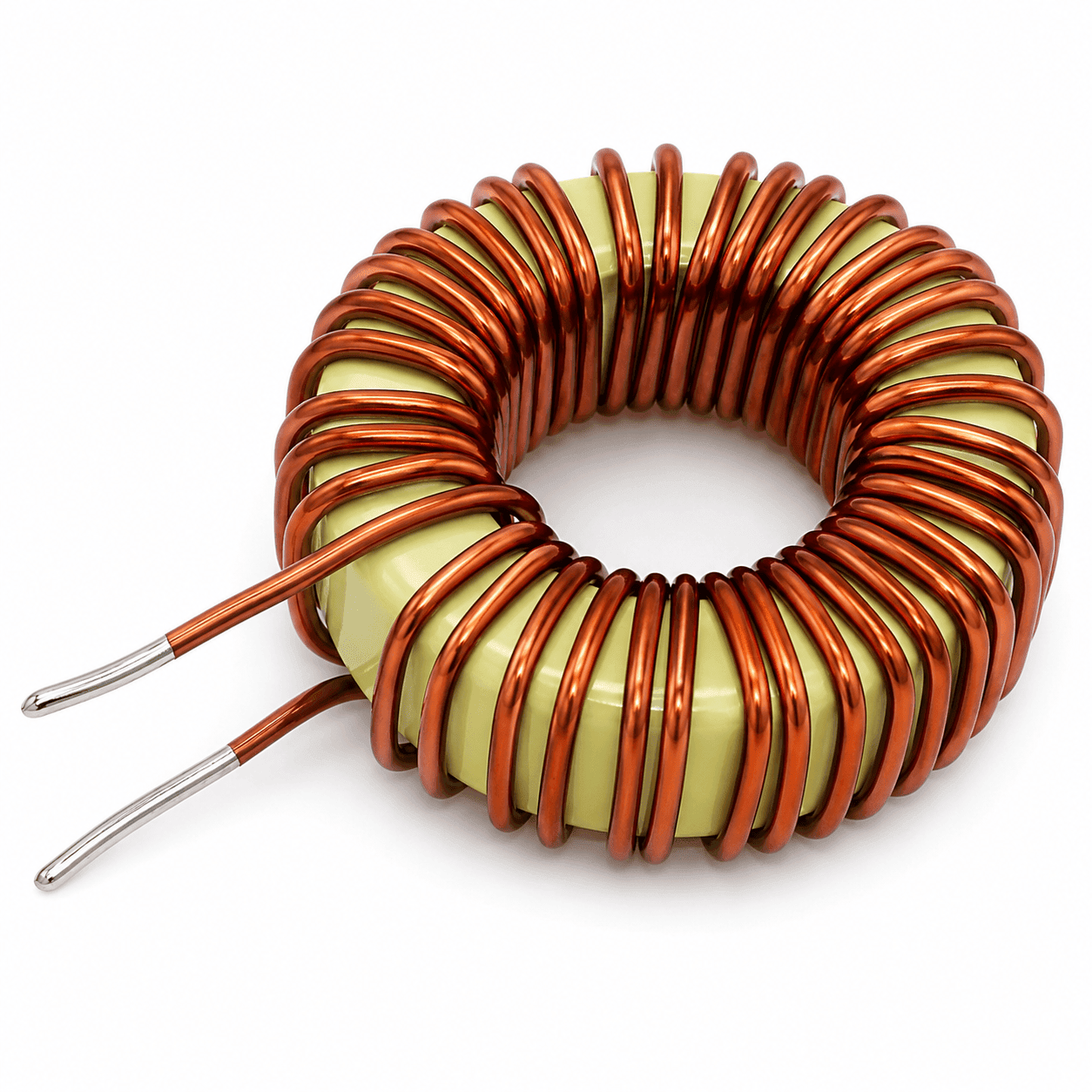
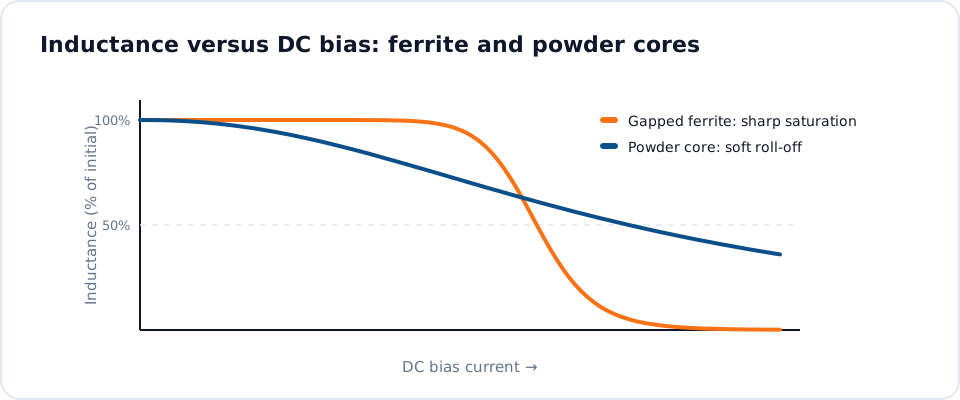
Iron powder toroids suit this duty because their distributed air gap gives a gradual, predictable fall in inductance in place of the abrupt collapse seen in an ungapped ferrite ring. The closed toroidal path also keeps stray field low, which helps when the choke sits close to control circuitry. We are an ISO 9001:2015 certified company, and every unit is checked for inductance, DCR, Q factor, saturation current and hipot before dispatch.
 ISO 9001:2015 certified
The figures below are the real limits of our standard and custom ranges. Values that depend on your circuit are set during design and confirmed on the approved sample.
| Inductance range (standard) | 10 µH to 10 mH |
|---|---|
| Inductance range (custom) | 1 µH to 50 mH |
| Current rating | Up to 25 A standard; higher on custom designs |
| Core materials | Iron powder and ferrite toroids; MPP, Sendust and High Flux through the custom range |
| Winding options | Single heavy-gauge wire or multi-strand copper |
| Saturation current and DCR | Specified per design; measured on every unit |
| Mounting formats | Through-hole, chassis and flying-lead |
| Testing | 100% electrical test: inductance, DCR, Q factor, saturation current, hipot |
| Compliance | RoHS and REACH compliant materials; certificate copies available on request |
Temperature rise, lead length and footprint are specified per design.
As an industrial toroidal choke supplier we deal with a handful of power stages again and again.
Boost and output filter inductors carry a large DC or line-frequency current with switching ripple on top. Inductance held at peak current decides how well that ripple is controlled.
Enquire now
Battery-side chokes and inverter output filters run for long periods at high RMS current, so copper cross-section and temperature rise matter as much as saturation.
Enquire now
PFC and DC output stages need chokes that keep their inductance through the full charging current, without the core running hot inside a closed cabinet.
Enquire now
Drives and DC bus supplies use toroidal chokes to smooth current and limit ripple. Overload peaks belong in the specification so that the core is sized for them.
Enquire nowStock parts you can order today. View details, add to cart or enquire for a custom variant.

Share inductance at bias, peak and RMS current, frequency and footprint. We reply with a technical quotation within 24 working hours. Email sales@ngelectronics.in or call +91 83290 52861.
Inductance in a powder core falls as DC bias rises, following a curve that depends on the material, the core size and the number of turns. More turns give more inductance at low current but also more magnetising force per ampere, so the curve rolls off sooner. A larger core or a lower permeability material pushes the roll-off to a higher current, at the cost of size or of extra turns and copper resistance.
Heating is the second constraint. Copper loss rises with the square of RMS current and with DCR, which is why high current parts use thick wire or several strands wound in parallel. Core loss depends on the ripple amplitude and switching frequency, not on the DC level. The surface temperature the part reaches also depends on airflow and neighbouring components, so the final check should be made in your own assembly.


NG Electronics was founded in 2017 by Nishant Gaikwad and today works with a team of 50+ at Chimbli, Pune. As a toroidal power inductor supplier we wind on semi-automatic toroidal machines and test with LCR testers, impulse testers, insulation breakdown testers and power analysers under the same roof. Nothing is sent out for winding, so a design change agreed with our engineers reaches the shop floor without a third party in between.
Being ISO 9001:2015 certified means each batch carries records that trace it back to raw material and production date, and a test certificate is supplied with orders on request. Buyers who want a toroidal inductor manufacturer in India for repeat orders get a technical quotation within 24 working hours, flexible minimum quantities from about 10 pieces for R&D work, and delivery across the country from Pune. Enquiries from outside India are welcome too.
Call, WhatsApp or use the form with inductance, current and quantity.
Price, lead time and datasheet within 24 working hours.
Sample built in-house for your lab testing and approval.
Production with 100% electrical testing under ISO 9001:2015.
Packed with a test certificate, shipped across India or exported worldwide.
Answers about high current toroidal inductor manufacturer from NG Electronics, an ISO 9001:2015 certified company
Our standard toroidal power inductors are rated up to 25 A across 10 µH to 10 mH. For higher currents we design custom parts using heavier gauge or multi-strand copper on a suitably larger core. The achievable rating depends on the inductance, permitted temperature rise and available space, so we confirm it in the technical quotation and do not quote a blanket figure.
Saturation current is the DC level at which inductance has dropped by a stated percentage from its zero-bias value. Rated or RMS current is the level that produces a stated temperature rise from copper and core losses. A part can be limited by either one.
Several strands in parallel give the same copper cross-section as one heavy wire but are easier to wind tightly on a toroid and lie flatter against the core. At higher switching frequencies, dividing the conductor can also reduce the extra AC resistance caused by skin effect.
Iron powder is the usual economical choice and handles DC bias well, though its core loss is comparatively high at higher frequencies. Sendust runs cooler, and High Flux typically holds inductance furthest into DC bias among the common powder materials, at a higher cost. MPP offers very low loss. Ungapped ferrite toroids saturate early and suit low-bias filtering. Alloy powder cores are offered through our custom wound range.
Every unit is electrically tested for inductance, DCR, Q factor, saturation current and hipot using LCR testers, impulse testers and insulation breakdown testers in our Pune facility. Results are tied to batch records that trace back to raw material and production date. A test certificate is supplied with the order on request.
Stock items typically dispatch within 24 hours. Custom samples typically take 7 to 10 working days once the specification is agreed. Minimum quantities are flexible: about 10 pieces for R&D and prototyping, single-piece prototype samples for custom designs, and typically 100 to 1,000 pieces for custom production runs.
Standard range 10 µH to 10 mH, up to 25 A.
Learn more
Custom toroidal inductor manufacturer in Pune, ISO 9001:2015 certified
Learn moreToroidal inductor for solar inverter boost and output filter stages from an ISO 9001:2015 certified Pune maker
Learn more
Estimate turns and inductance for your core.
Learn moreSend your specification or drawing for high current toroidal inductor manufacturer. NG Electronics is an ISO 9001:2015 certified company, and every enquiry is answered by our engineering and sales team in Pune.



These products are limited, checkout within

Smart configuration workspace setup.


