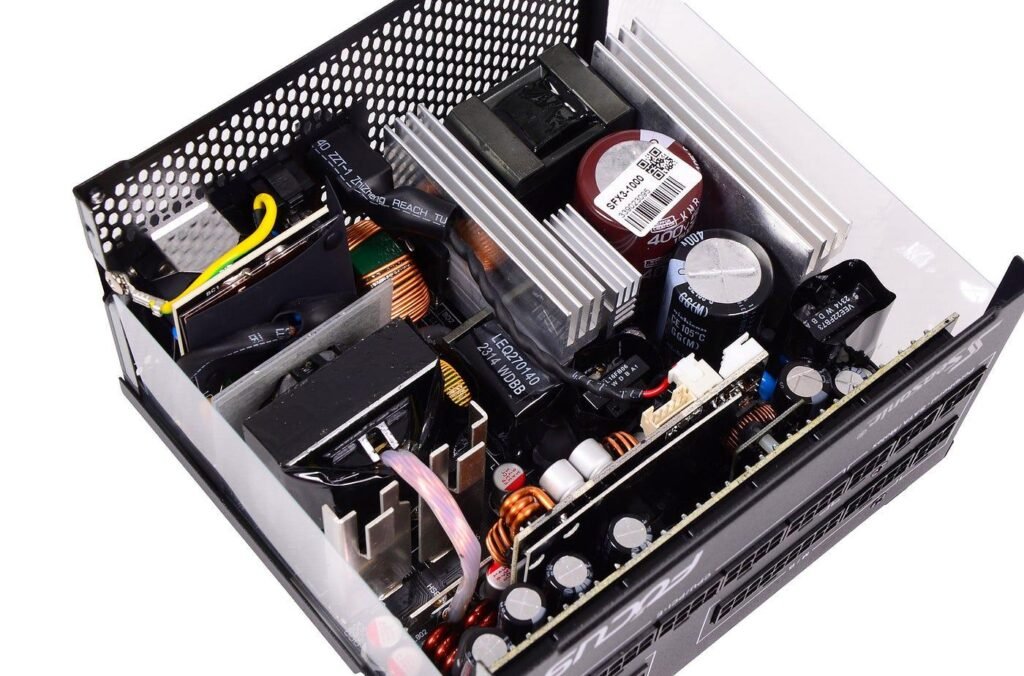
Data centre power supply magnetics sit in every stage between the utility connection and the processor: in the UPS, in the rack power supply and on the server board itself. As computing loads grow denser, the power chain is being asked for higher efficiency across a wide load range and more output from the same rack space. Those demands are met largely through better semiconductors and topologies, but the inductors, chokes and transformers determine how far each improvement can be taken.
This is an educational overview of where magnetic components are used in data centre power conversion and how their requirements are changing. It describes directions qualitatively and gives no market figures. Components for this sector are almost always built to the equipment maker's own specification, so the article also notes which parameters a designer should define when requesting custom parts from a manufacturer.
Key takeaways
- Every stage of a server power supply depends on a different kind of magnetic component.
- Light-load efficiency makes core loss as important as copper loss.
- Resonant stages treat leakage and magnetising inductance as toleranced circuit values.
- Parts for this sector are specified individually, with airflow and consistency stated.
Where magnetics sit in the data centre power chain
Power typically passes through a UPS, is distributed to racks, and is converted by rack-mounted or in-server power supplies to a DC bus, from which point-of-load converters feed the processors and memory. Each power supply contains an EMI filter, a power factor correction stage, an isolated DC-DC stage and auxiliary supplies. The guide to magnetics for UPS and energy storage covers the upstream equipment; this article concentrates on the power supply itself.
The functions have not changed, but the operating conditions have. Supplies run continuously, often at partial load, in warm airflow, and are expected to remain efficient from light load to full load. That makes no-load and light-load losses in the magnetics, mainly core loss, as important as full-load copper loss. It also places a premium on consistent parts, because many identical supplies operate in parallel and share current according to their characteristics.
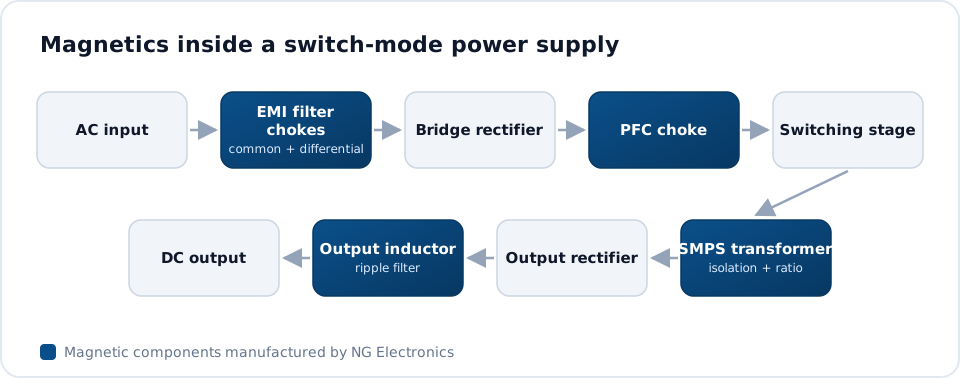
- Input EMI filter: common mode chokes and differential-mode inductors
- PFC stage: boost choke carrying line-frequency current with switching ripple
- Isolated DC-DC stage: main transformer and, in resonant designs, a resonant inductor
- Auxiliary and standby supplies: small flyback and gate-drive transformers
- Output and point-of-load stages: low-inductance, high-current inductors
PFC chokes and the move to higher frequency
The PFC choke stores energy every switching cycle while carrying the rectified line current. Its inductance sets the ripple, following the same proportionality as any switching inductor: ripple falls as inductance or frequency rises. Wide-bandgap switches and bridgeless topologies allow higher frequencies and lower conduction loss, which reduces the inductance required but raises core loss per unit volume. Details of the trade-off are in the article on PFC choke design and selection.
Core choice depends on how the stage operates. With continuous conduction and modest ripple, powder cores such as Sendust or High Flux tolerate the DC bias well. With large ripple, as in critical-conduction or interleaved designs, gapped ferrite and stranded conductors keep AC loss down. Toroidal power inductors on iron powder or ferrite cores are widely used for boost and filter positions, and a toroidal inductor for an SMPS can be wound to the exact inductance and current the stage requires.
Isolation transformers and resonant stages
The isolated stage in an efficient server supply is commonly a resonant converter, because soft switching keeps losses low across the load range. Here the transformer's magnetising and leakage inductances form part of the resonant tank, so they carry tolerances like any other circuit value. The background is given in LLC resonant transformer basics. Low-voltage, high-current secondaries need few turns of heavy or foil conductor, and termination resistance becomes a meaningful part of the loss.
Insulation between primary and secondary must meet the safety standard for the equipment, which fixes creepage, clearance and hipot levels and so constrains the winding layout. A high-frequency ferrite transformer supplier should receive the frequency range, turns ratio, inductance and leakage targets, insulation requirement and thermal conditions together. Smaller ferrite core transformers also appear throughout the supply as standby flyback, gate-drive and isolation parts, and these are frequently custom as well.
EMI filtering at high power density
Dense, fast-switching supplies generate noise over a wide band, and many units share one distribution system, so input filtering is taken seriously. The filter combines common mode chokes, differential-mode inductance and capacitors, usually in two stages. Emission limits such as those in CISPR 32 apply to information technology equipment. Because the filter can occupy a noticeable share of the supply's volume, designers look for core materials with high permeability and winding styles that keep parasitic capacitance low.
Nanocrystalline cores are often chosen where high impedance is needed in a small volume, with MnZn ferrite as the established alternative. Common mode chokes must also carry the full line current without overheating, so copper cross-section and DC resistance are specified alongside impedance. For higher input currents, a high-current common mode choke on a ring core with sectional winding offers a workable balance of current capacity, leakage inductance for differential filtering and isolation between the two windings.
Specifying data centre power supply magnetics as custom parts
Because each supply design has its own frequency plan, form factor and airflow, magnetics for this sector are specified individually. A complete request states topology, frequency range, inductance and tolerance, DC, ripple and peak currents, permitted loss or temperature rise, airflow direction and velocity, height limit, footprint and insulation requirements. Consistency between units should be expressed as tolerances on the parameters that affect current sharing and resonance, and confirmed by per-unit testing.
NG Electronics is an ISO 9001:2015 certified manufacturer in Pune, India, building custom inductors, chokes and ferrite transformers to customer specifications. Its ferrite transformers range from under 1 VA up to several hundred watts, standard toroidal inductors cover up to 25 A with higher currents available as custom designs, and common mode chokes extend to 50 A. Requirements beyond those ranges are best discussed at the enquiry stage. Every unit is electrically tested, and overseas enquiries are welcome.
Frequently asked questions
Which magnetic components does a server power supply contain?
A typical unit has common mode and differential-mode chokes in the input filter, a PFC boost choke, a main isolation transformer, often a resonant inductor, output filter inductors, and small transformers for standby power and gate drive. Point-of-load converters on the server board add further inductors. Each has different priorities, from impedance in the filter to low loss in the resonant stage.
Why is light-load efficiency important for these magnetics?
Data centre supplies spend much of their life below full load, particularly where redundant units share the demand. Core loss is present whenever the converter switches and depends little on load, so it dominates at light load. Selecting a low-loss core material and an appropriate flux swing therefore improves efficiency across the range, not only at the rated output.
Can NG Electronics supply magnetics for data centre power equipment?
NG Electronics builds custom inductors, common mode chokes and ferrite transformers to the customer's specification, within its stated ranges of current and power. Send the electrical, mechanical and insulation requirements, and a technical quotation typically follows within 24 working hours, with a sample for laboratory approval before production. Parts are wound and tested in-house.
About NG Electronics
NG Electronics is a leading ISO 9001:2015 certified manufacturer of toroidal power inductors, common mode chokes, ferrite core transformers, line filter inductors, drum core inductors and custom wound magnetic components, based in Pune, India. Every part is wound and 100% electrically tested in-house. Send the electrical, thermal and mechanical requirements for your power supply magnetics to NG Electronics to receive a technical quotation and a sample.