A factory floor is a demanding place for electronics. Motor drives switch large currents a few metres from sensors that resolve millivolts, cabinets run warm, and equipment is expected to stay in service for a decade or more. Magnetics for industrial automation sit at every boundary in this environment: between the mains and the drive, between the 24 V supply and the controller, and between noisy power wiring and sensitive signals.
This article surveys where transformers, inductors and chokes are used in automation equipment and what makes a part suitable for the duty, from the cabinet inlet down to the individual input and output module. NG Electronics is an ISO 9001:2015 certified manufacturer in Pune, India, serving panel builders, drive makers and control equipment OEMs, and it welcomes specifications from engineering teams overseas.
Key takeaways
- Line reactors add impedance that lowers harmonic currents and protects drive rectifiers.
- Three-phase common mode chokes control the noise driven through motor cable capacitance.
- Control supply transformers provide the safety isolation between mains and 24 V circuits.
- Batch consistency and traceability matter because industrial products have long lifecycles.
Where magnetics for industrial automation are found
Start at the cabinet inlet. A three-phase supply feeds variable frequency drives and servo amplifiers through line reactors and EMI filters. A DIN-rail power supply converts mains to 24 V DC for programmable controllers, input and output modules, sensors and actuators. Inside each module, small DC-DC converters produce logic voltages, and isolated stages separate field wiring from the control electronics. Communication ports carry their own common mode chokes.
The parts range from heavy three-phase reactors to surface-mount inductors of a few millimetres, yet the selection questions are shared: the current to be carried without saturation, the inductance needed across the operating range, the insulation level and the temperature inside the enclosure. Getting these right at the design stage is cheaper than tracing an intermittent fault on a running production line.
Line reactors and filters for drives
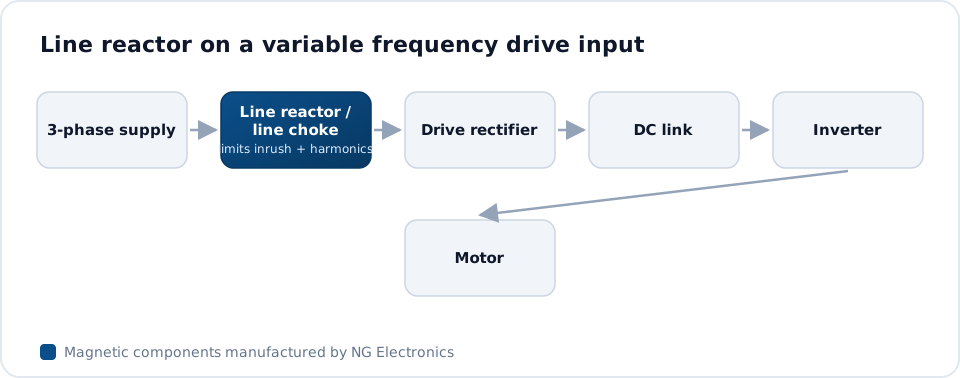
A drive with a diode rectifier draws current in short pulses, and a line reactor in series with each phase adds impedance that spreads those pulses, lowers harmonic currents and protects the rectifier from supply transients. Reactors are typically rated by their percentage impedance at rated current. NG Electronics includes line reactors for three-phase panels within its line filter inductors, which cover 500 mA to about 50 A.
The inverter side of the drive is a strong source of common mode noise, because fast voltage edges drive current through the capacitance of the motor cable and windings to earth. Three-phase common mode chokes on nanocrystalline or ferrite ring cores, rated up to 50 A, are used in the input filter and sometimes at the output. The mechanisms are explained in EMI in motor drives and VFD systems and in three-phase EMI filter basics.
Transformers in control power supplies
The 24 V supply is usually a flyback converter at lower power and a forward, half-bridge or LLC converter above that. Its transformer provides the safety isolation between mains and the control circuit, so insulation construction, creepage and clearance are as important as the electrical parameters. Industrial supplies often accept a wide input range, including operation between two phases, which increases the voltage stress and the insulation requirement on the primary side.
Gate-drive transformers in drives and isolated converters in input and output modules are smaller but equally critical, since they must withstand fast common mode transients without disturbing the signal. Options for these parts are covered on the SMPS transformer and industrial power supply transformer pages, with core shapes including EE, EF, ETD, EER, RM and PQ, all wound, taped and varnished in-house.
Inductors for point-of-load and signal integrity
Controller boards carry several buck converters that step 24 V down to 5 V, 3.3 V and lower rails. Their inductors follow the usual rule: ripple equals the voltage across the inductor multiplied by the on-time and divided by inductance, and the peak must stay under the saturation rating. Shielded drum core inductors from 1 µH to 1 mH limit stray field near analogue inputs and communication interfaces.
Signal and data lines leaving the cabinet pick up common mode interference along their length. Small chokes at the port attenuate that noise while leaving the differential signal largely unaffected, provided leakage inductance and winding capacitance are suited to the data rate. On the mains side, single-phase and three-phase filter chokes do the equivalent job for power wiring, and their construction is described on the AC line filter choke page.
Environment, lifecycle and sourcing
Automation equipment faces vibration, temperature cycling, dust and occasionally oil mist. Varnished or impregnated windings resist movement and moisture, secure terminations survive vibration, and a conservative temperature rise extends insulation life. Enclosures are often sealed, so the ambient around the magnetics may be far above room temperature, and inductance at peak current should be verified with the part hot rather than assumed from a room-temperature measurement.
Industrial products have long lifecycles, and a component that changes silently between batches can cause field problems that are hard to diagnose. Consistent materials, documented test results and batch traceability to raw material and production date reduce that risk. The OEM inductor manufacturing page describes how NG Electronics handles repeat orders, with 100 per cent electrical testing and test certificates supplied on request.
- Supply voltage, phase count and rated current of the drive or panel
- Required inductance or percentage impedance, and peak current
- Insulation level, test voltage and enclosure temperature
- Mounting style: chassis, PCB through-hole, SMD or flying leads
Frequently asked questions
What does a line reactor do in front of a variable frequency drive?
It adds series impedance in each phase. This lengthens the conduction period of the rectifier diodes, which lowers harmonic currents and peak current, and it limits the rate of rise of current during supply transients. Reactors are typically specified by percentage impedance at rated current, with the choice depending on the supply and the harmonic target.
Why do drives need common mode chokes?
The inverter output has fast voltage edges that drive current through the capacitance between the motor cable, the motor windings and earth. This current returns through the supply and appears as conducted emission. A common mode choke raises the impedance of that path and, with capacitors, forms a filter that keeps emissions within the applicable limits.
What quantities can be ordered for a new automation design?
Quantities are flexible. Around 10 pieces is usual for R&D and prototyping, and single-piece prototype samples are possible for custom designs. Production minimums for custom parts are typically 100 to 1,000 pieces. Stock items typically dispatch within 24 hours, and custom samples are typically ready within 7 to 10 working days.
About NG Electronics
NG Electronics is a leading ISO 9001:2015 certified manufacturer of toroidal power inductors, common mode chokes, ferrite core transformers, line filter inductors, drum core inductors and custom wound magnetic components, based in Pune, India. Every part is wound and 100% electrically tested in-house. Send your drive, panel or control supply specification to NG Electronics at sales@ngelectronics.in for a technical quotation, typically within 24 working hours, and a sample for approval.