
Chargers and adapters
Low-power mains adapters and battery chargers almost always use a flyback. The part count is low and the transformer provides the isolation.
Enquire now


NG Electronics · ISO 9001:2015 Certified Company
Both are single-switch isolated converters, yet their transformers work in opposite ways. NG Electronics, an ISO 9001:2015 certified manufacturer in Pune, winds both types and explains where each fits.
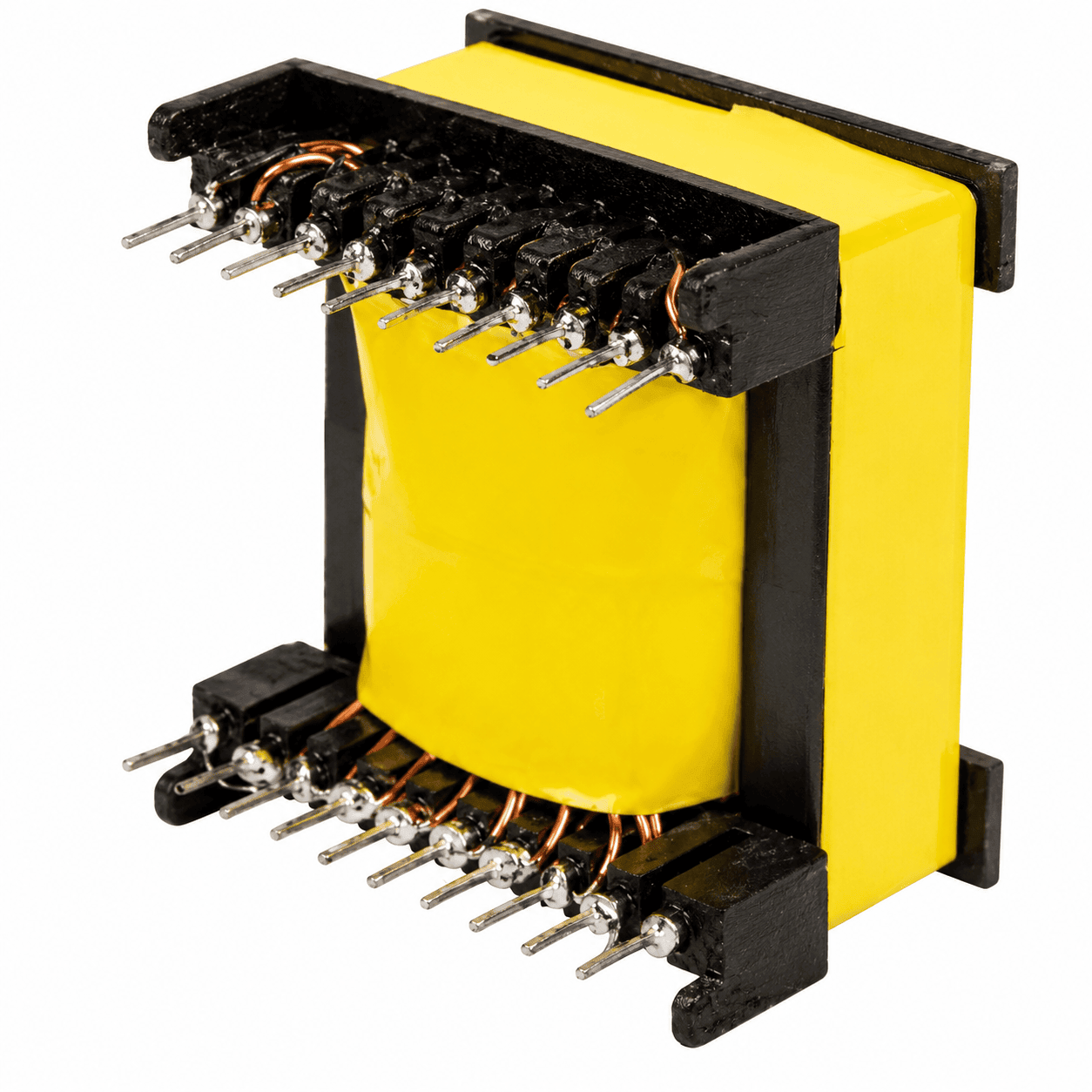
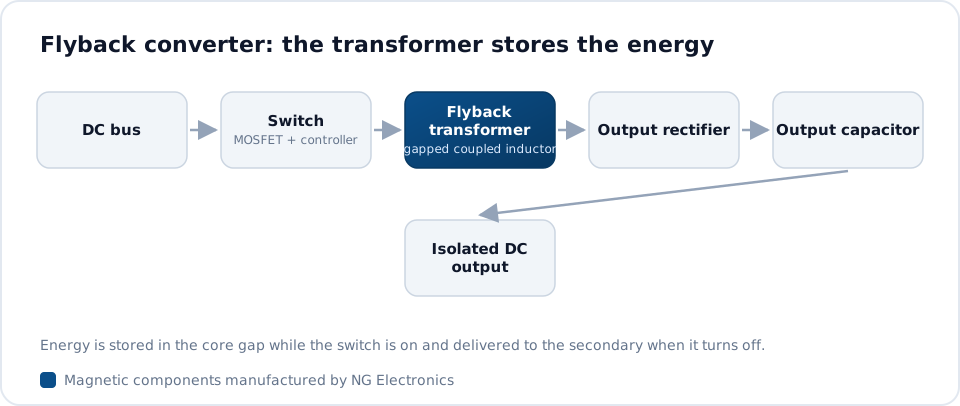
The flyback vs forward transformer question comes up early in almost every isolated power supply design, and it is really a question about where energy is stored. A flyback transformer is a coupled inductor: energy goes into the core gap while the switch is on and is released to the output when it turns off. A forward transformer is a true transformer that passes energy to the secondary during the on-time.
That one difference shapes the rest of the circuit. Because the flyback core stores energy, it is gapped, its primary inductance is a controlled design value, and no output inductor is required. The forward converter transformer stores very little energy, so the core is normally ungapped or only lightly gapped, but the converter needs a separate output inductor, a freewheel diode and a way to reset the core flux in every cycle.
When comparing a flyback transformer vs forward converter transformer on cost, count the whole power stage. The flyback has fewer parts and handles several outputs easily, which is why it dominates at lower power. As output current rises, its high peak and RMS currents load the switch, the secondary rectifier and the output capacitors heavily, and the forward converter, with continuous inductor current at its output, becomes the calmer choice.
 ISO 9001:2015 certified
A quick comparison for engineers deciding which SMPS topology to use. Power figures are typical industry guidance, not hard limits.
| Energy transfer | Flyback: stored in the core, delivered in the off-time. Forward: delivered during the on-time. |
|---|---|
| Core gap | Flyback: gapped to store energy. Forward: ungapped or a small gap only. |
| Primary inductance | Flyback: a controlled value with tolerance. Forward: a minimum value is usually enough. |
| Output inductor | Flyback: not needed. Forward: required, one per output or a coupled inductor. |
| Core reset | Flyback: inherent in operation. Forward: reset winding, clamp or two-switch arrangement needed. |
| Typical power range | Flyback: typically up to about 100 to 150 W. Forward: typically from about 100 W to several hundred watts. |
| Multiple outputs | Flyback: simple, one winding and diode per output. Forward: possible, with more parts. |
| Output ripple current | Flyback: high, pulsed into the capacitors. Forward: low, smoothed by the inductor. |
| Leakage inductance | Flyback: causes a voltage spike that a snubber or clamp must absorb. Forward: less critical but still kept low. |
NG Electronics can quote both constructions against the same specification so you can compare.
Where each topology is normally found.
Low-power mains adapters and battery chargers almost always use a flyback. The part count is low and the transformer provides the isolation.
Enquire now
Housekeeping supplies in solar inverters, UPS systems and EV chargers need several small isolated rails. A multi-output flyback transformer delivers them from one core.
Enquire now
Control-panel supplies delivering high current at a low output voltage favour the forward converter, because its output inductor keeps capacitor ripple current and output noise manageable.
Enquire now
DC-fed converters at moderate power often use single-switch or two-switch forward stages, valued for low output ripple.
Enquire nowStock parts you can order today. View details, add to cart or enquire for a custom variant.
Send your input range, outputs and switching frequency to sales@ngelectronics.in or WhatsApp +91 83290 52861. We will suggest a flyback or forward construction and return a technical quotation within 24 working hours.
In a flyback all the energy passes through the core gap, so core size and peak current grow quickly with power. The stored energy per cycle follows E = 1/2 L I^2, which means more power calls for a higher peak current, a larger inductance carrying that current, or a higher frequency. Beyond roughly 100 to 150 W, typically, the stress on the switch and capacitors makes other topologies more attractive.
Then look at the secondary side. A forward transformer carries current in primary and secondary at the same time, so its peak currents are lower for the same power and the output inductor smooths what reaches the capacitors. The price is extra magnetics and a reset scheme that limits duty cycle, commonly to about 50 percent in the single-switch version with a reset winding of equal turns.


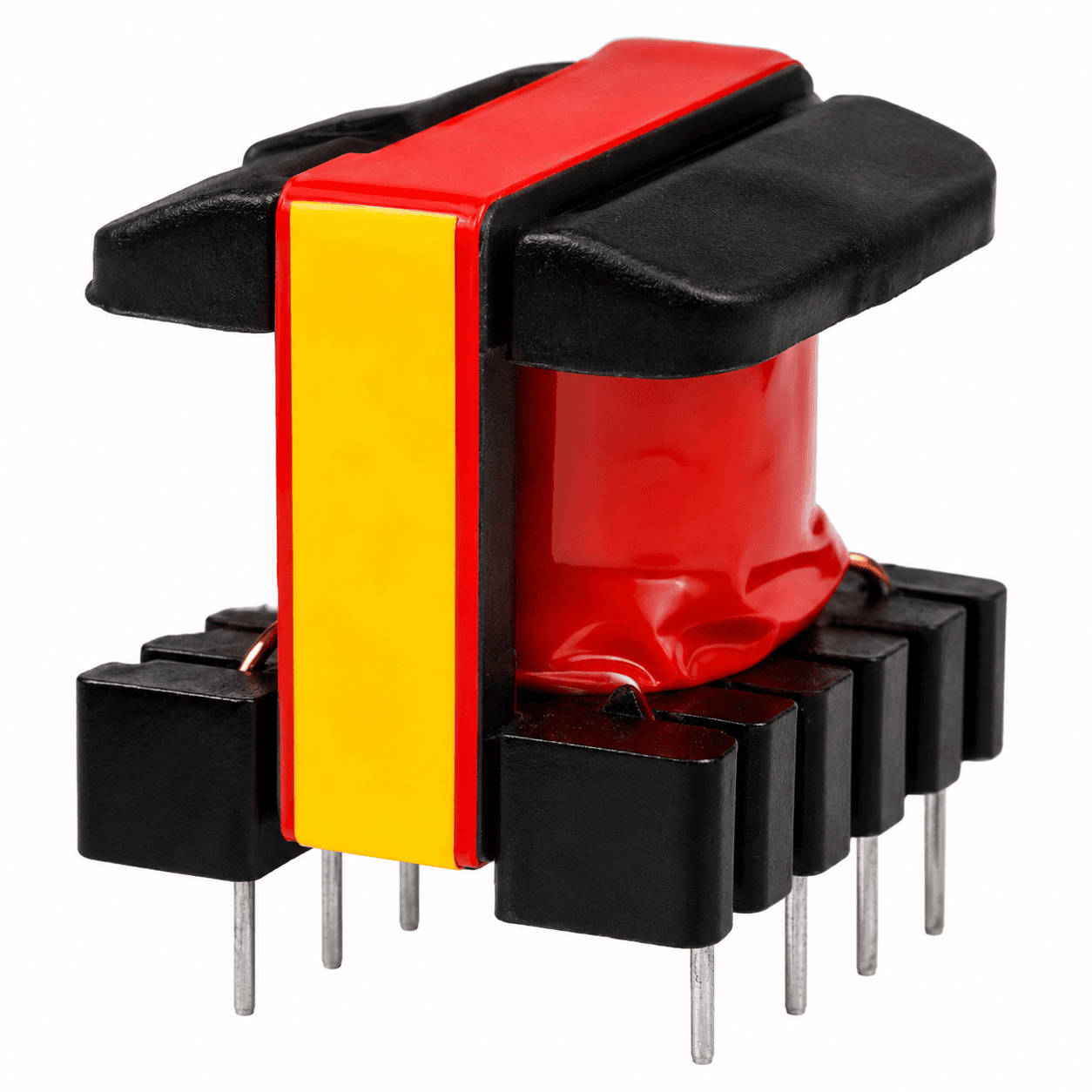
NG Electronics is an ISO 9001:2015 certified manufacturer in Pune that builds flyback, forward, push-pull, gate-drive and isolation transformers from under 1 VA up to several hundred watts. The two types ask different things of a winder. A flyback depends on a consistent gap and a tight inductance tolerance; a forward transformer depends on close coupling and a correctly phased reset winding. Both are checked on automatic transformer testers before dispatch.
Because inductors are wound in the same plant, the output choke for a forward converter can be designed alongside its transformer, on iron powder or ferrite toroidal cores from 10 µH to 10 mH as standard. Every unit is electrically tested, batch records give traceability to raw material and production date, and materials are RoHS and REACH compliant, with certificate copies available on request. Overseas enquiries are welcome.
Call, WhatsApp or use the form with inductance, current and quantity.
Price, lead time and datasheet within 24 working hours.
Sample built in-house for your lab testing and approval.
Production with 100% electrical testing under ISO 9001:2015.
Packed with a test certificate, shipped across India or exported worldwide.
Answers about flyback vs forward transformer from NG Electronics, an ISO 9001:2015 certified company
A flyback transformer stores energy in a gapped core during the switch on-time and delivers it to the load during the off-time. A forward transformer transfers energy directly while the switch is on and stores almost none. The forward converter therefore needs an output inductor and a core reset method, while the flyback does not.
There is no fixed threshold. Flyback converters are typically used up to about 100 to 150 W, and forward converters typically from around 100 W to several hundred watts. High output current at low voltage favours the forward topology earlier, because flyback capacitor ripple current becomes hard to manage.
Ferrite has high permeability and would saturate at a small current if the magnetic path were closed. The gap lowers effective permeability, so the core can carry the peak primary current without saturating, and most of the energy is stored in the gap itself. Gap length together with primary turns sets the primary inductance.
During the on-time, magnetising current builds up in the core. If that flux is not returned to its starting point before the next cycle, it accumulates and the core saturates. A reset winding, an active or passive clamp, or a two-switch arrangement returns the magnetising energy.
Yes. Toroidal power inductors are one of our product families, with standard values from 10 µH to 10 mH at up to 25 A and custom values from 1 µH to 50 mH. The output choke can be specified together with the forward transformer so the two parts are sampled, tested and approved as a set.
The flyback is usually simpler. Each extra output needs only a secondary winding, a diode and a capacitor, and the outputs track one another reasonably well. A forward converter needs an inductor for every output, or a coupled inductor wound on one core. Cross-regulation in either case depends on winding coupling.
Flyback transformer manufacturer in Pune, ISO 9001:2015 certified
Learn moreSMPS transformer manufacturer in Pune, ISO 9001:2015 certified
Learn moreHow to specify a custom ferrite transformer: the design inputs a winder needs, from an ISO 9001:2015 certified
Learn more
Transformer winding configurations and insulation explained: layers, interleaving, margins and tape
Learn moreSend your specification or drawing for flyback vs forward transformer. NG Electronics is an ISO 9001:2015 certified company, and every enquiry is answered by our engineering and sales team in Pune.



These products are limited, checkout within

Smart configuration workspace setup.


