
Adaptors and open-frame supplies
Small UU-core chokes ahead of the rectifier in flyback supplies, where board area is tight and the input current is a fraction of an ampere to a few amperes.
Enquire now


NG Electronics · ISO 9001:2015 Certified Company
NG Electronics is an ISO 9001:2015 certified manufacturer of common mode chokes for switch-mode power supplies, from compact 250 mA UU-core PCB parts to toroidal chokes for higher-power input stages.
A common mode choke for SMPS use sits at the very front of the supply, between the mains inlet and the bridge rectifier. Its task is to stop switching noise generated inside the converter from travelling out along the mains cable. NG Electronics winds these chokes in Pune in inductances from 1 mH to 100 mH, starting with compact UU-core parts rated at 250 mA for adaptors, chargers and auxiliary supplies.
The noise it deals with originates at the switching node. Each time the main transistor turns on or off, the fast voltage edge drives current through stray capacitance: across the transformer from primary to secondary, and from the transistor tab to its heatsink. That current returns through earth and appears equally on live and neutral. Because it is small in amplitude but high in frequency, a high-impedance series element is the effective way to block it.
For low-power supplies the UU core is a practical shape. Each winding sits on its own leg in its own bobbin section, the pins fit a standard through-hole footprint, and the part is suited to automated winding. As power rises, a toroid on a base becomes the better option because it offers more inductance for a given volume and a closed magnetic path with little stray field.
 ISO 9001:2015 certified
Standard build options for power supply input filters are listed here. Footprint, pin pitch and height are set to match your board.
| Inductance range | 1 mH to 100 mH |
|---|---|
| Current rating | From 250 mA (UU core) up to 50 A (ring core) |
| Core types | UU ferrite cores; MnZn ferrite and nanocrystalline toroids |
| Winding styles | Sectional, bifilar and split |
| Mounting | PCB mount; pin layout specified per design |
| Testing | 100% tested for inductance, DCR, Q factor, saturation current and hipot |
| Compliance | RoHS and REACH compliant materials; certificate copies available on request |
| Prototype quantity | About 10 pieces for R&D; single-piece samples possible |
Stock parts are listed in the online catalogue and typically dispatch within 24 hours.
Almost every mains-connected switching supply carries at least one of these parts.
Small UU-core chokes ahead of the rectifier in flyback supplies, where board area is tight and the input current is a fraction of an ampere to a few amperes.
Enquire now
Chokes on DC input lines and rectifier modules, where conducted noise must be kept off shared power buses feeding sensitive radio and network equipment.
Enquire now
Input filters for equipment where earth leakage has to be kept low, which restricts Y capacitance and puts more of the filtering burden on the choke.
Enquire now
Switching supplies inside amplifiers and mixers, where residual noise on the mains or earth can otherwise find its way into low-level signal paths.
Enquire nowStock parts you can order today. View details, add to cart or enquire for a custom variant.


Email the input voltage range, maximum input current, target inductance and footprint drawing to sales@ngelectronics.in, or message +91 83290 52861 on WhatsApp. We respond with a technical quotation within 24 working hours.
The inductance printed on a datasheet is measured at low frequency and tells only part of the story. What the filter experiences is impedance, which changes across the band. Impedance rises with frequency while the part behaves as an inductor, reaches a peak near self-resonance, then falls as winding capacitance takes over. Ferrite also becomes lossy at higher frequencies, so near the peak the choke behaves largely as a resistor, which helps by damping noise instead of reflecting it.
Winding style shapes that curve. In a sectional winding the two coils occupy separate parts of the core. This gives low capacitance between them, a useful amount of leakage inductance for differential-mode filtering, and physical distance between live and neutral. A bifilar winding lays the two wires side by side, so coupling is very tight and leakage is minimal, but only the wire insulation separates the conductors. For that reason bifilar parts suit low-voltage DC lines far better than mains inputs.
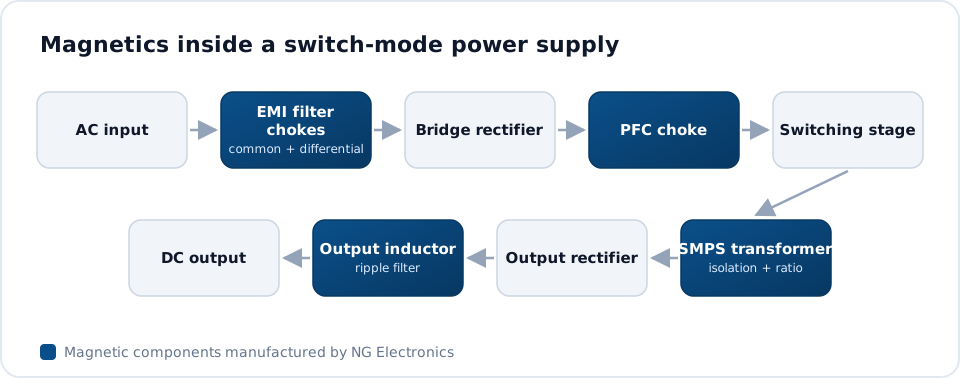


Power supply designers usually need a choke that fits a footprint already fixed on the board, at a quantity that large catalogue vendors do not find interesting. As a custom common mode choke manufacturer, NG Electronics takes on that kind of work: a specific pin pitch, a height limit, or an inductance between standard values. The company was founded in 2017 by Nishant Gaikwad and all winding is done in-house.
Quality control is built into the route rather than added at the end. We are an ISO 9001:2015 certified company, and each choke is measured for inductance, DCR and insulation strength before it is packed. The hipot test matters particularly for mains input parts, since it confirms the insulation between the two windings. Materials are RoHS and REACH compliant, and certificate copies are available on request for your technical file.
Call, WhatsApp or use the form with inductance, current and quantity.
Price, lead time and datasheet within 24 working hours.
Sample built in-house for your lab testing and approval.
Production with 100% electrical testing under ISO 9001:2015.
Packed with a test certificate, shipped across India or exported worldwide.
Answers about common mode choke for SMPS from NG Electronics, an ISO 9001:2015 certified company
Begin with the maximum input current and the frequencies at which your supply exceeds the emission limit. Choose an inductance that gives enough impedance at the lowest of those frequencies, then check that self-resonance lies high enough to keep impedance up across the rest of the band. Finally confirm the copper loss and footprint.
A UU core carries each winding on a separate leg in a bobbin, so it winds quickly on linear machines, gives good separation between windings and drops onto a standard pinned footprint. It suits low currents from about 250 mA. A toroid gives more inductance per unit volume and less stray field, so it is preferred as current and power increase.
Sectional winding keeps the two coils apart on the core, which lowers inter-winding capacitance, adds some leakage inductance and provides spacing between conductors. Bifilar winding places both wires together turn by turn, giving very tight coupling and almost no leakage, at the cost of higher capacitance between windings and insulation that relies on the wire coating alone.
In a mains filter one winding carries live and the other neutral, so the full line voltage, plus any surge, appears between them. Adequate creepage and clearance, usually achieved with a divider or separate bobbin sections, prevent breakdown. The exact distances depend on the safety standard and working voltage of your product, so please state those requirements when you enquire.
Many low-power supplies pass with one choke and a pair of Y capacitors. A second stage is considered when the required attenuation is large, when noise at high frequency bypasses the first choke through its winding capacitance, or when leakage current limits rule out larger Y capacitors. Two smaller chokes with different characteristics often cover the band better than one large part.
Yes. Around 10 pieces is a normal quantity for R&D work, and a single prototype sample can be made for a custom design. Catalogue parts held in stock typically dispatch within 24 hours. For custom chokes, samples typically follow in 7 to 10 working days, with production batches usually starting from 100 to 1,000 pieces.

EMI suppression chokes from 250 mA to 50 A.
Learn more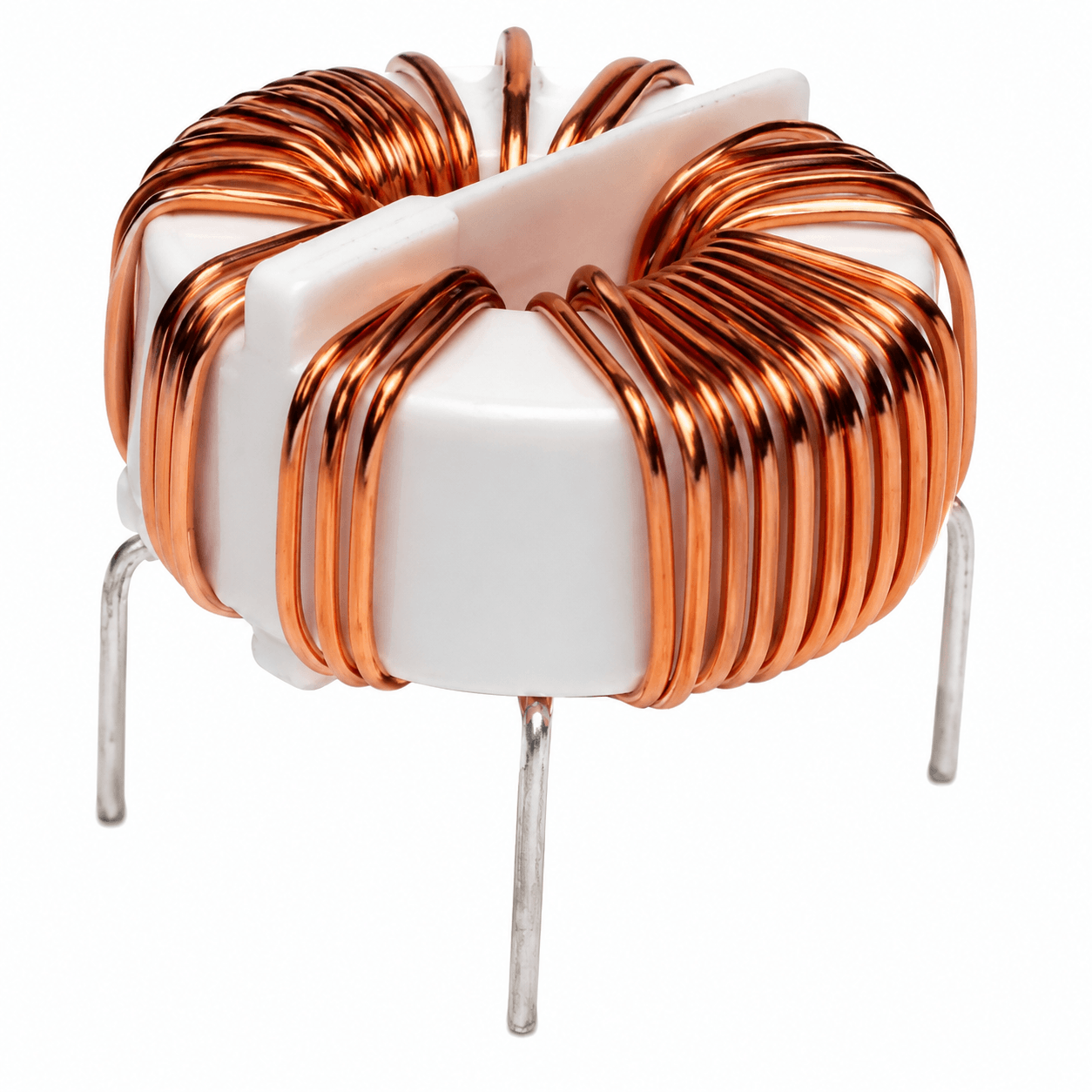
EMI filter choke manufacturer in Pune, ISO 9001:2015 certified
Learn more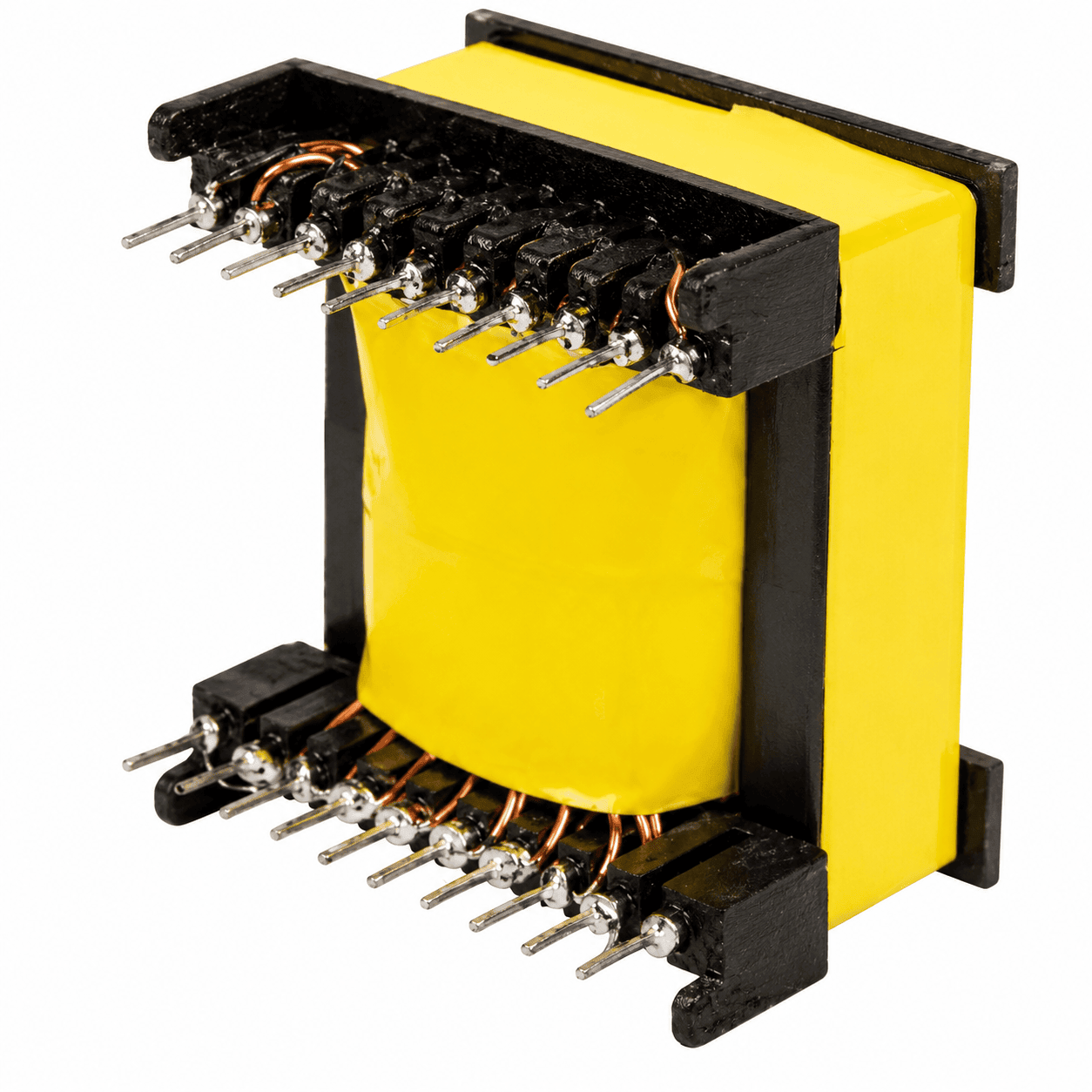
SMPS transformer manufacturer in Pune, ISO 9001:2015 certified
Learn more
Toroidal inductor for SMPS output filter and PFC stages, made in Pune by ISO 9001:2015 certified NG Electronic
Learn moreSend your specification or drawing for common mode choke for SMPS. NG Electronics is an ISO 9001:2015 certified company, and every enquiry is answered by our engineering and sales team in Pune.



These products are limited, checkout within

Smart configuration workspace setup.


