
SMPS input filters
Common mode and differential chokes at the mains input reduce conducted noise, supporting designs that must meet emission limits such as CISPR 32 and CISPR 14.
Enquire now


NG Electronics · ISO 9001:2015 Certified Company
NG Electronics is an ISO 9001:2015 certified choke coil manufacturer in India, winding common mode, line, toroidal and drum chokes in Pune to catalogue specifications or to your drawing.
A choke coil is an inductor named for its job: it chokes off unwanted alternating current, such as switching noise or ripple, while letting direct current or mains-frequency current pass. Electrically the two are the same component, a winding on a core, but a part described as a choke is selected mainly for the impedance it presents to noise. NG Electronics is a choke coil manufacturer in India producing these parts for power supplies, inverters, chargers and industrial panels.
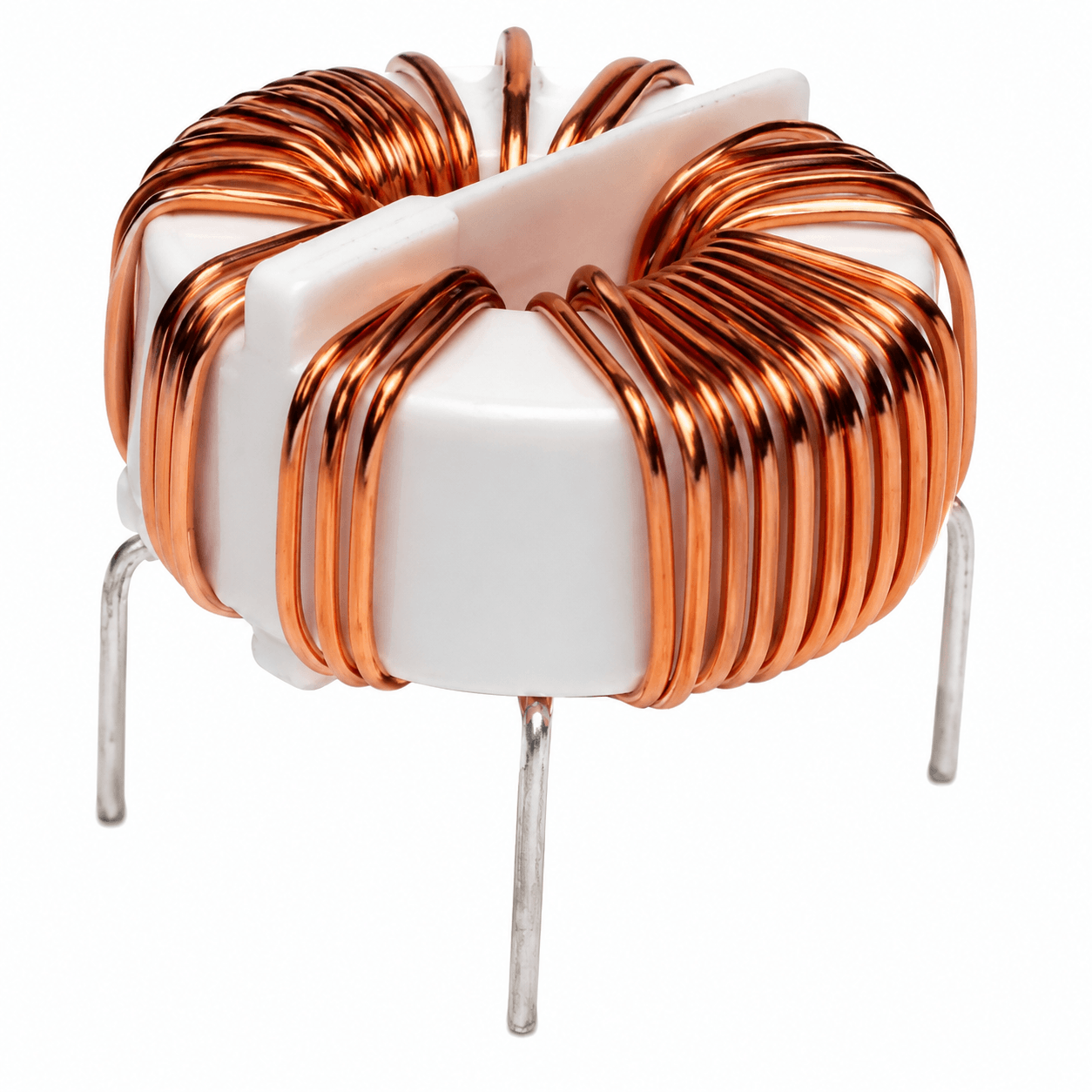
Four types cover most requirements. Common mode chokes carry two or three windings on one core and suppress noise that flows in the same direction on all lines. Differential-mode line chokes sit in series with a conductor and work against noise between lines. Toroidal power chokes smooth ripple current at the output of a converter, and drum chokes do the same task on small, low-current rails.
Winding is the centre of the work. Our Pune plant runs semi-automatic toroidal winding machines for ring cores and linear winding machines for bobbin and drum parts, and the same equipment supports coil winding services for customers who supply their own drawing. As an electronic coil winding manufacturer, we handle sectional, bifilar and split winding, single and multi-strand copper, and finishing as PCB-mount, chassis-mount or flying-lead parts.
 ISO 9001:2015 certified
Ranges below are grouped by choke type. A requirement outside these figures can be reviewed as a custom design.
| Common mode choke current | 250 mA (compact UU-core PCB chokes) to 50 A (ring-core chokes, including three-phase) |
|---|---|
| Common mode choke inductance | 1 mH to 100 mH |
| Line choke range | 500 mA to about 50 A; 100 µH to 10 mH; toroidal, EE and UU cores |
| Toroidal power choke range | 10 µH to 10 mH standard, up to 25 A; custom 1 µH to 50 mH |
| Drum choke range | 1 µH to 1 mH; shielded and unshielded; SMD, radial and axial |
| Core materials | High-permeability MnZn ferrite, nanocrystalline and iron powder; MPP, Sendust and High Flux for custom parts |
| Winding options | Sectional, bifilar and split winding; toroidal and linear machine winding |
| Testing | 100% electrical test: inductance, DCR, Q factor, saturation current, hipot |
| MOQ | About 10 pieces for R&D; custom production typically 100 to 1,000 pieces |
Impedance against frequency, temperature rise and dimensions are specified per design. Materials are RoHS and REACH compliant; certificate copies are available on request.
Almost every product with a switching stage or a mains connection needs at least one choke. Typical uses for our parts include the following.
Common mode and differential chokes at the mains input reduce conducted noise, supporting designs that must meet emission limits such as CISPR 32 and CISPR 14.
Enquire now
High-current ring-core common mode chokes, including three-phase versions, filter the grid connection of chargers and inverters.
Enquire now
Line reactors and filter chokes for three-phase panels reduce the harmonics and noise conducted between drives and the supply.
Enquire now
Compact UU-core chokes and drum chokes filter DC rails and driver inputs where board space is tight.
Enquire nowStock parts you can order today. View details, add to cart or enquire for a custom variant.


Email sales@ngelectronics.in or WhatsApp +91 83290 52861 with your drawing or electrical requirement. We reply within 24 working hours and can follow with a free sample.
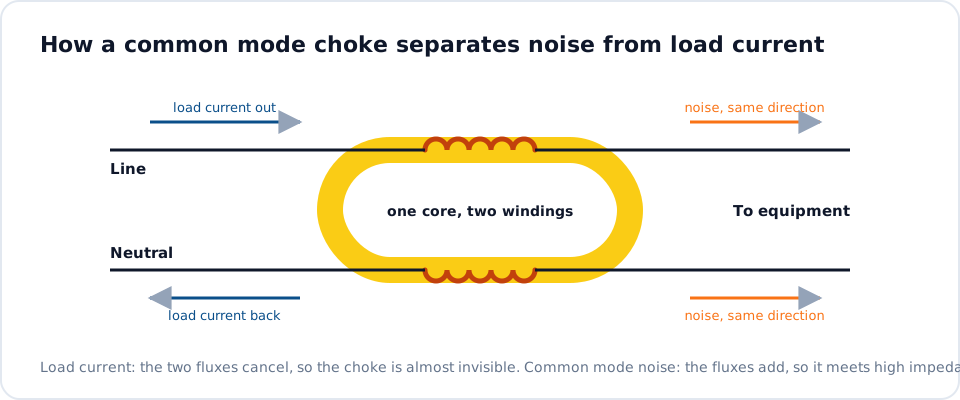
In a common mode choke the line and return currents produce opposing flux, which cancels in the core. That lets a high-permeability ferrite or nanocrystalline core be used without saturating under load current, giving high inductance in a small part. Noise that travels the same way on both conductors does not cancel and so meets the full impedance. A differential-mode choke has no such cancellation, so its core must carry the whole load current without saturating.
How the turns are laid matters as much as the core. Sectional winding places each winding on its own part of the toroid, which improves isolation between lines and leaves some leakage inductance that helps with differential noise. Bifilar winding lays two wires side by side for tight coupling and low leakage, which suits low-voltage and signal lines. The choice is made against the voltage between windings and the noise spectrum to be filtered.


Consistent winding is what makes a choke repeatable, and that depends on process control. NG Electronics is an ISO 9001:2015 certified company, founded in 2017, with a team of more than 50 working at our Pune facility. Winding on semi-automatic machines, together with batch records that trace material and production date, helps keep one lot of chokes matching the next.
Each choke is tested electrically before dispatch, including inductance, DCR and hipot, with impulse testers and insulation breakdown testers available for insulation checks. As a choke manufacturer in India serving customers in every state, we quote within 24 working hours, offer a free sample for approval and can supply a test certificate with the consignment when asked. Catalogue chokes held in stock typically leave within 24 hours of order.
Call, WhatsApp or use the form with inductance, current and quantity.
Price, lead time and datasheet within 24 working hours.
Sample built in-house for your lab testing and approval.
Production with 100% electrical testing under ISO 9001:2015.
Packed with a test certificate, shipped across India or exported worldwide.
Answers about choke coil manufacturer India from NG Electronics, an ISO 9001:2015 certified company
There is no physical difference; a choke coil is an inductor used to block or attenuate unwanted AC, such as switching noise or ripple, while passing DC or mains current. The term inductor is broader and includes parts used for energy storage or tuning.
As a choke coil manufacturer in India, we make common mode chokes from 250 mA to 50 A, differential-mode line chokes from 500 mA to about 50 A, toroidal power chokes up to 25 A in the standard range, and drum core chokes from 1 µH to 1 mH.
Yes. Send the drawing or a specification with inductance, current, voltage between windings, dimensions and mounting details. We can match an existing part or propose a core and winding of our own. A single-piece prototype is possible for custom designs, samples are typically ready within 7 to 10 working days, and production MOQ is typically 100 to 1,000 pieces.
We wind coils to customer drawings on our semi-automatic toroidal and linear winding machines. This covers toroidal chokes, bobbin-wound and drum parts, and custom coils on ferrite, iron powder, nanocrystalline or air cores. Sectional, bifilar and split winding are available. Share the winding details and quantity, and we will confirm feasibility in a technical quotation within 24 working hours.
Nanocrystalline cores typically have higher permeability than MnZn ferrite and hold it over a wider temperature range, so a common mode choke can reach the required inductance with fewer turns or a smaller core. Ferrite remains economical and is suitable for many designs. The decision depends on the noise frequencies, the current and the space available.
A choke is one part of an EMI filter, and compliance with standards such as CISPR 32 or CISPR 14 is tested on the finished equipment, not on the component. We help by selecting core material, inductance and winding style for the noise you measure, and by supplying samples so you can verify the result in your own lab or pre-compliance test.

EMI suppression chokes from 250 mA to 50 A.
Learn more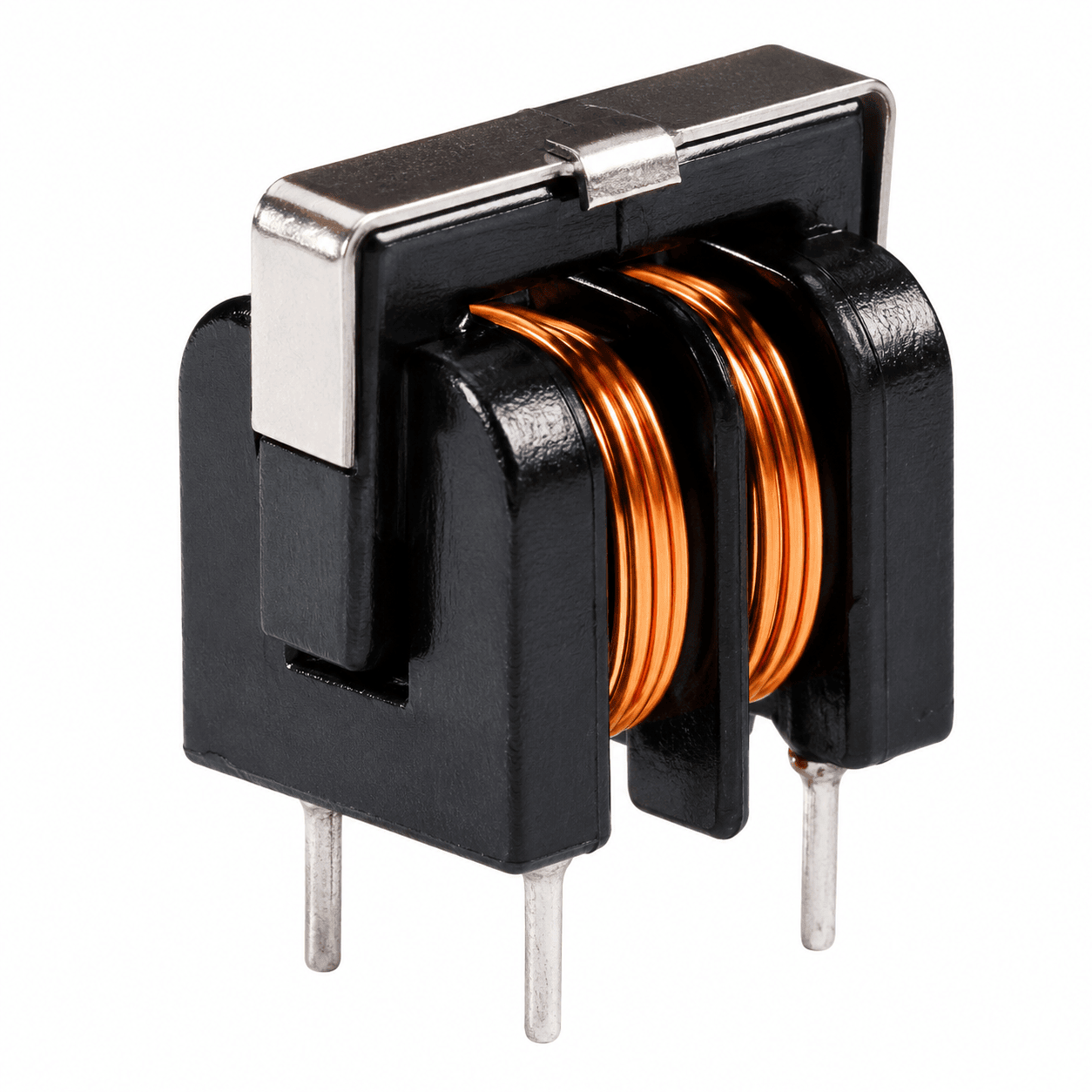
Line chokes and reactors from 500 mA to about 50 A.
Learn moreEMI filter choke manufacturer in Pune, ISO 9001:2015 certified
Learn moreAC line filter choke manufacturer in Pune, ISO 9001:2015 certified
Learn moreSend your specification or drawing for choke coil manufacturer India. NG Electronics is an ISO 9001:2015 certified company, and every enquiry is answered by our engineering and sales team in Pune.



These products are limited, checkout within

Smart configuration workspace setup.


