
UPS battery chargers
The charger in a UPS restores the battery after an outage and then holds it on float. The inductor runs continuously, so low DCR and modest temperature rise count for more than size.
Enquire now


NG Electronics · ISO 9001:2015 Certified Company
As an ISO 9001:2015 certified battery charger inductor supplier, NG Electronics winds toroidal chokes in Pune for buck, boost and bidirectional charging stages and tests every piece for inductance, DCR and saturation current.
A battery charger inductor supplier has to understand what the charger does over a whole charge cycle, because the inductor never sits at one operating point. In the constant-current phase it carries full output current into a low battery voltage. As the battery fills, the charger moves to constant voltage and the current tapers towards a small maintenance level. The inductor must stay out of saturation at the start and still control ripple properly at the end.
In most chargers the power stage is a buck converter, or a boost or buck-boost stage where the source voltage is below the battery voltage. The inductor carries a DC current equal to the charging current with a triangular ripple on top. In a buck stage that ripple equals the voltage across the inductor during the on-time, multiplied by the duty cycle and divided by inductance and switching frequency.
Ripple matters to the battery as well as to the electronics. Excess ripple current adds heating in the cells and in the output capacitors, and with lead-acid and lithium packs alike most designers prefer to keep it small relative to the charging current. A larger inductance lowers ripple but adds turns, copper loss and size. Choosing the DC-DC inductor for battery charging is therefore a balance between ripple, DC resistance, saturation margin and the space on the board.
 ISO 9001:2015 certified
Each battery charger choke is built around the charging current and switching frequency of your converter. The figures below come from our toroidal power inductor family.
| Inductance, standard | 10 µH to 10 mH |
|---|---|
| Inductance, custom | 1 µH to 50 mH |
| Rated current | Up to 25 A standard; higher with heavier gauge or multi-strand copper |
| Core materials | Iron powder and ferrite toroidal cores; MPP, Sendust and High Flux as custom builds |
| Saturation current | Specified per design; verified on each unit |
| DC resistance | Specified per design; verified on each unit |
| Mounting | Through-hole, SMD, chassis or flying leads |
| Testing | Inductance, DCR, Q factor, saturation current and hipot on 100% of units |
| Compliance | RoHS and REACH compliant materials; certificate copies available on request |
Stock values typically leave within 24 hours. Custom samples typically need 7 to 10 working days, and a test certificate is supplied with orders on request.
Requests for inductors for battery systems come from several industries, and it is the charging current, not the industry, that decides the part.
The charger in a UPS restores the battery after an outage and then holds it on float. The inductor runs continuously, so low DCR and modest temperature rise count for more than size.
Enquire now
Chargers for electric vehicles use a DC-DC stage after the PFC front end. Output inductors here carry high charging current and need saturation margin for current-limit overshoot.
Enquire now
A buck stage between the panel and the battery tracks the panel's power point. Input voltage swings widely with sunlight, so ripple has to be checked across the whole range.
Enquire now
Rectifier shelves and backup packs for control panels charge batteries while feeding the load. Filter inductors keep ripple and noise away from sensitive equipment.
Enquire nowStock parts you can order today. View details, add to cart or enquire for a custom variant.

Tell us the input range, battery voltage, charging current, switching frequency and ripple target. Email sales@ngelectronics.in or WhatsApp +91 83290 52861 and we will reply with a technical quotation.
Start from V = L di/dt. During the on-time of a buck stage the inductor sees the difference between input and battery voltage, and its current ramps up; during the off-time it sees the battery voltage in reverse and ramps down. The inductance needed is whatever keeps that ramp within the ripple you have chosen at your switching frequency. Many designers begin with a peak-to-peak ripple of typically 20 to 40 per cent of charging current and adjust from there.
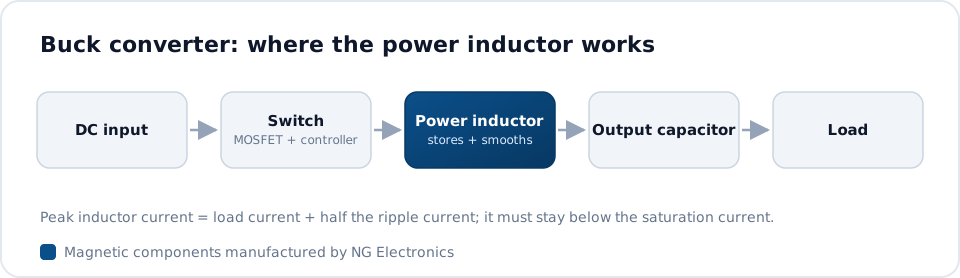
Peak current is the DC charging current plus half the ripple, and the core must carry that with margin at its highest working temperature. Stored energy follows E = 1/2 L I^2, so doubling the current at the same inductance asks four times as much of the core. Iron powder toroids tolerate DC bias well and saturate gradually, which makes them a frequent choice for chargers; gapped ferrite offers lower core loss where the switching frequency or ripple is high.


Chargers are often built in steady volumes over a long product life, so what matters is that later inductors behave like the approved sample. NG Electronics is an ISO 9001:2015 certified manufacturer and supplier founded in 2017, and winding is done on semi-automatic toroidal machines at our Pune works. Inductance, DCR and saturation current are measured on each piece, and the batch record links every lot to its core and copper supply and its date of manufacture.
Buyers can start small. About 10 pieces is enough for R&D work, a single prototype is possible on a custom design, and production quantities for custom parts typically fall between 100 and 1,000 pieces. Quotations with technical detail are returned within 24 working hours of receiving your specification, and deliveries go to customers across India from Pune.
Call, WhatsApp or use the form with inductance, current and quantity.
Price, lead time and datasheet within 24 working hours.
Sample built in-house for your lab testing and approval.
Production with 100% electrical testing under ISO 9001:2015.
Packed with a test certificate, shipped across India or exported worldwide.
Answers about battery charger inductor supplier from NG Electronics, an ISO 9001:2015 certified company
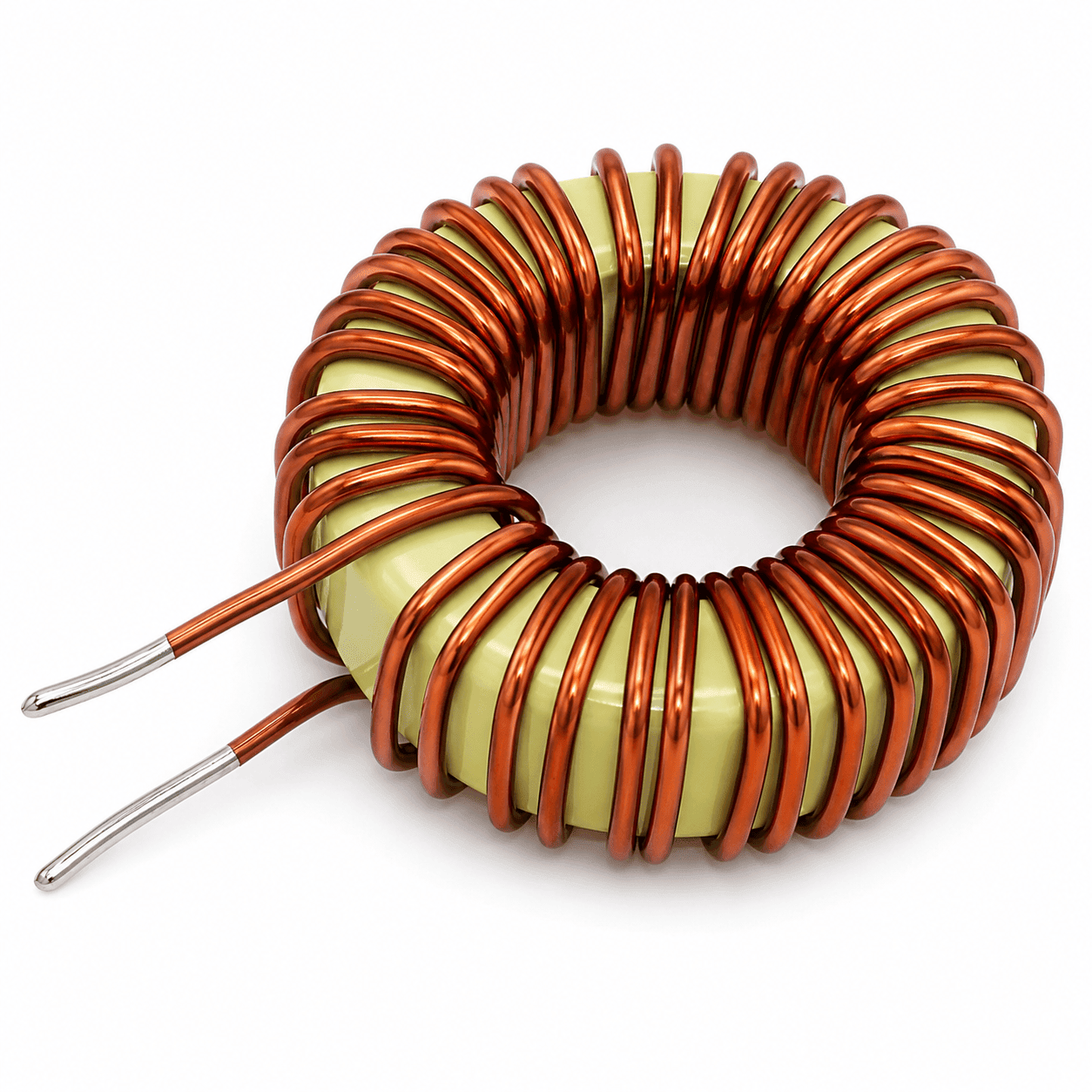
NG Electronics supplies toroidal power inductors for buck, boost and bidirectional charger stages. Standard parts span 10 µH to 10 mH with ratings up to 25 A. Where the design needs something else, custom inductors from 1 µH to 50 mH are wound with heavier gauge or multi-strand copper for higher currents, on iron powder, ferrite or other powder cores.
There is no single correct figure. Many buck charger designs start with a peak-to-peak ripple of typically 20 to 40 per cent of the charging current, then refine it. Lower ripple reduces heating in capacitors and cells and eases filtering, but requires more inductance, which increases size and winding resistance.
Iron powder toroids cope well with large DC current and lose inductance gradually as current rises, so a brief overshoot is tolerated. Their core loss is higher, which limits them when ripple or frequency is high. Gapped ferrite has lower loss but saturates suddenly, and earlier at high temperature. The better option depends on switching frequency, ripple and cost target.
With powder cores it does. Inductance is highest at light current and falls as DC bias increases, so the part has less inductance during bulk charging than during the taper phase. This is normal and is handled by specifying the minimum inductance required at full charging current, which we then verify during saturation current testing.
Yes. In a bidirectional stage the same inductor acts as the buck choke while charging and as the boost choke while the battery discharges into the DC bus. It must be rated for the larger of the two currents and checked for ripple in both directions, because the voltage across it and the duty cycle differ between the two modes.
Catalogue toroidal inductors held in stock typically dispatch within 24 hours. Custom samples typically take 7 to 10 working days, and the first sample for lab approval is supplied free. MOQ is flexible: about 10 pieces for prototyping, and typically 100 to 1,000 pieces for production of custom parts.
Standard range 10 µH to 10 mH, up to 25 A.
Learn more
Inductors for UPS systems from NG Electronics, Pune: ISO 9001:2015 certified maker of PFC, battery and inverte
Learn more
How to select an inductor for a DC-DC converter: ripple, peak current, DCR and shielding, from an ISO 9001:201
Learn moreEstimate turns and inductance for your core.
Learn moreSend your specification or drawing for battery charger inductor supplier. NG Electronics is an ISO 9001:2015 certified company, and every enquiry is answered by our engineering and sales team in Pune.



These products are limited, checkout within

Smart configuration workspace setup.


