
Point-of-load regulators
Buck stages of a few amperes on crowded logic boards typically use shielded SMD drum cores, which are compact and suit automated placement.
Enquire now


NG Electronics · ISO 9001:2015 Certified Company
Toroidal vs drum core inductors compared side by side by NG Electronics, an ISO 9001:2015 certified manufacturer in Pune that winds both types and can recommend either without bias.
The toroidal vs drum core inductors question usually arises when a design needs a power inductor and both shapes appear in the catalogue at the same value. The difference lies in the magnetic path. A toroid is a closed ring, so the flux stays inside the core for its whole journey. A drum core is a bobbin-shaped ferrite with the winding around its centre, and the flux has to return from one flange to the other through the air outside the winding.
That return path through air acts as a large gap. It lets a small ferrite drum store energy without saturating early, and it makes the part simple to wind by machine, which keeps cost and size down. The price is a stray magnetic field around the component. A toroid has very little external field and can use powder cores suited to high DC current, but each turn must be passed through the ring, so winding is slower and the part is usually larger.
In a toroidal inductor vs drum core decision, power level and surroundings settle most cases. Low and medium current regulators on dense boards favour drum cores. Higher current chokes, filter inductors and anything placed near sensitive circuitry favour toroids. NG Electronics manufactures both families in Pune, so the recommendation you receive depends on your circuit and not on what one production line happens to make.
 ISO 9001:2015 certified
A side-by-side summary of the two constructions. Ranges are those manufactured by NG Electronics; general behaviour is typical of each type.
| Magnetic path | Toroidal: closed ring. Drum core: open, with flux returning through air unless shielded. |
|---|---|
| Stray field | Toroidal: low. Unshielded drum: highest. Shielded drum: much reduced by the ferrite sleeve. |
| Inductance range | Toroidal: 10 µH to 10 mH standard, 1 µH to 50 mH custom. Drum core: 1 µH to 1 mH. |
| Current capability | Toroidal: up to 25 A standard, higher on custom designs. Drum core: specified per design. |
| Core materials | Toroidal: iron powder and ferrite. Drum core: ferrite. |
| Mounting formats | Toroidal: typically through-hole, flat or vertical on a base. Drum core: SMD, radial and axial. |
| Saturation behaviour | Powder toroids lose inductance gradually; ferrite drum cores fall more sharply near the limit. |
| Relative cost and size | Drum cores are typically smaller and cheaper at low power; toroids take longer to wind. |
A specific pair of parts should always be compared on measured saturation current, DCR and temperature rise.
Four typical cases show how current level and the surrounding circuitry point to one construction or the other.
Buck stages of a few amperes on crowded logic boards typically use shielded SMD drum cores, which are compact and suit automated placement.
Enquire now
Boost and output chokes carrying high DC current with ripple are normally toroids on powder cores, where gradual saturation and low stray field both help.
Enquire now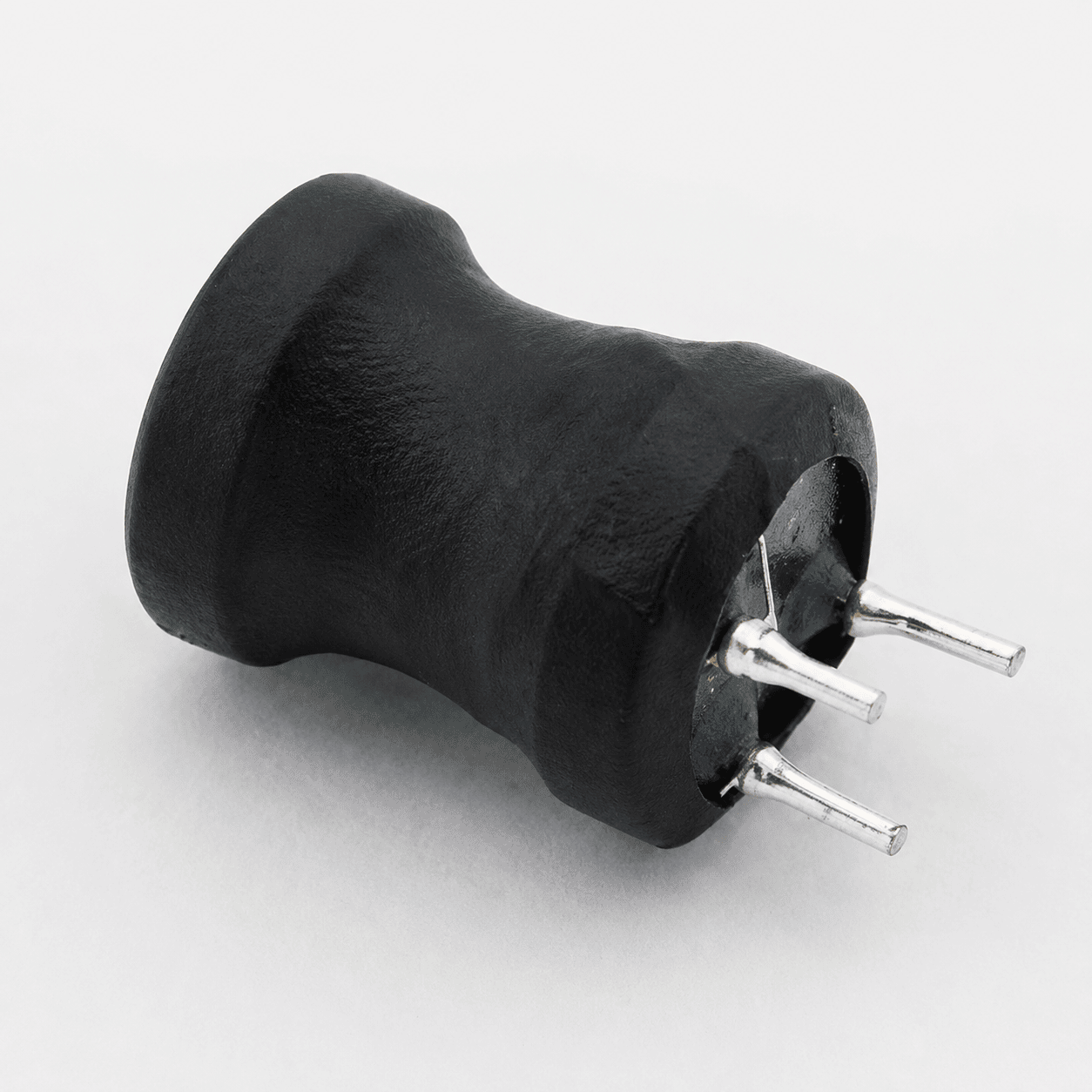
Cost-sensitive drivers commonly use radial drum cores. A sleeved version is chosen when the inductor must sit close to the control circuit.
Enquire now
Where hum pickup or coupling into signal paths is a concern, the self-contained field of a toroid is typically the safer option.
Enquire nowStock parts you can order today. View details, add to cart or enquire for a custom variant.
Send your current, inductance, switching frequency and height limit to sales@ngelectronics.in, or call or WhatsApp +91 83290 52861, Monday to Saturday, 9am to 7pm.
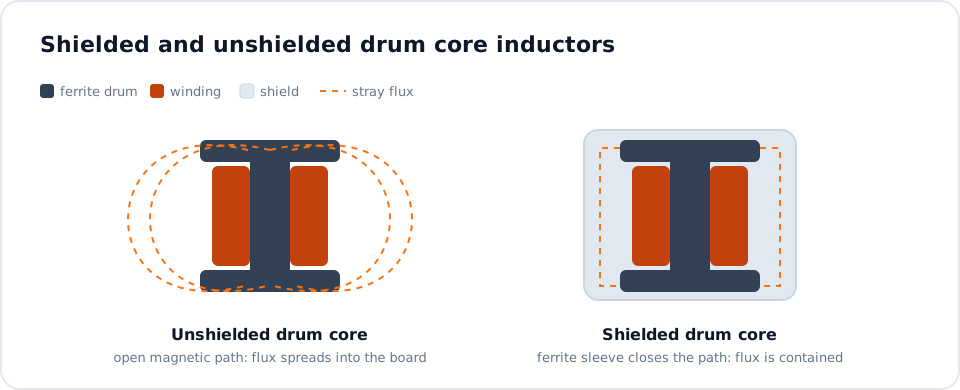
A fair shielded inductor comparison has three candidates, not two. The open drum core radiates the most, and its field couples into nearby traces, other inductors and metal parts. Adding a ferrite sleeve around the drum gives the flux a return path through ferrite, which contains most of the field. Because the remaining gap is smaller, a shielded drum typically has a lower saturation current than an unshielded one of the same size and inductance.
A toroid is self-shielding by geometry when the winding is spread evenly around the ring, although a winding covering only part of the core leaks more. It also allows powder materials whose distributed gap tolerates heavy DC bias. Mounting an unshielded drum near steel or another inductor can also shift its inductance, which is worth checking on the actual board.


A supplier with one product line tends to recommend that line. NG Electronics is an ISO 9001:2015 certified company that produces toroidal power inductors on semi-automatic toroidal winding machines and drum core inductors in SMD, radial and axial formats, all in the same Pune facility. Both families go through the same 100% electrical test for inductance, DCR, Q factor, saturation current and hipot before dispatch.
When the choice is not obvious, samples of both constructions let you decide from measurements instead of datasheets. Share the circuit details and a technical quotation reaches you within 24 working hours; custom samples typically take 7 to 10 working days, and R&D quantities begin at about 10 pieces. Production MOQ for custom parts is typically 100 to 1,000 pieces, with delivery across India and overseas enquiries welcome.
Call, WhatsApp or use the form with inductance, current and quantity.
Price, lead time and datasheet within 24 working hours.
Sample built in-house for your lab testing and approval.
Production with 100% electrical testing under ISO 9001:2015.
Packed with a test certificate, shipped across India or exported worldwide.
Answers about toroidal vs drum core inductors from NG Electronics, an ISO 9001:2015 certified company
A toroidal inductor is wound on a closed ring, so nearly all the magnetic flux stays inside the core. A drum core inductor is wound on a ferrite bobbin whose flux returns through the surrounding air unless a shield is added. Toroids therefore radiate less and suit higher currents, while drum cores are smaller, cheaper and easier to supply in SMD form.
For load currents up to a few amperes on a compact board, a shielded drum core is the usual choice because of its size and cost. For higher currents, or where efficiency and temperature rise are critical, a toroid on a suitable powder or ferrite core often runs cooler. The deciding factors are peak current, available space and nearby circuitry.
It has the lowest stray magnetic field of the three common constructions, which helps with coupling into nearby circuits. It does not remove conducted noise by itself, and a toroid wound over only part of the ring leaks more than a fully wound one.
A drum core is wound like a bobbin: the core spins and wire is laid on at speed, which suits automation. On a toroid every turn has to pass through the centre hole, using a shuttle on a toroidal winding machine or by hand for heavy wire. That takes longer per part.
It contains the field far better, but there is a trade-off. The shield reduces the effective air gap, so for the same size and inductance a shielded part typically saturates at a lower current. If the inductor has clear space around it and emissions are not marginal, an unshielded drum gives more current headroom for the money.
Yes. Toroidal power inductors are offered from 10 µH to 10 mH as standard and 1 µH to 50 mH on custom designs, and drum core inductors from 1 µH to 1 mH, shielded or unshielded. Custom samples typically follow within 7 to 10 working days.

Shielded and unshielded, SMD, radial and axial.
Learn more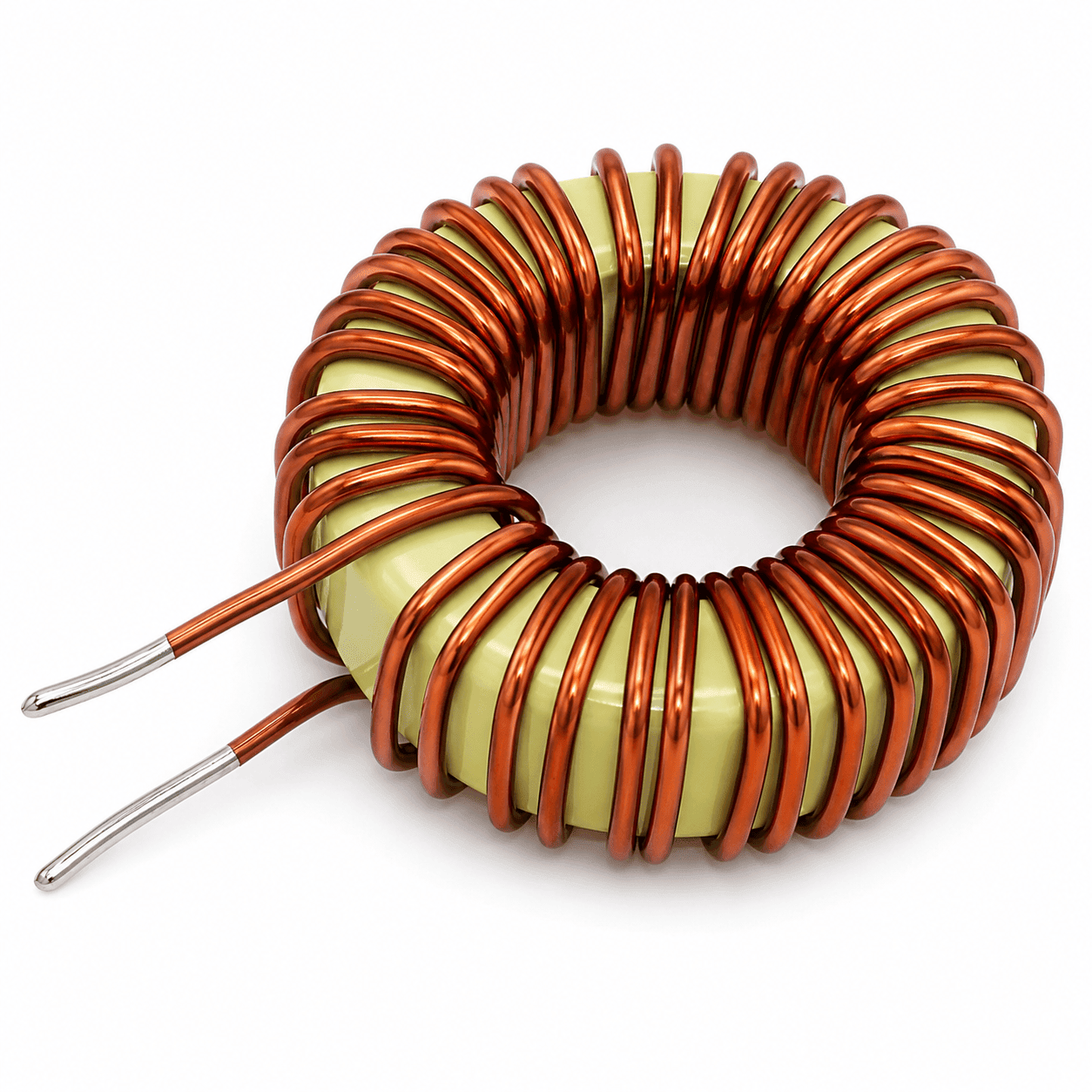
Standard range 10 µH to 10 mH, up to 25 A.
Learn moreShielded drum core inductor supplier in Pune: 1 µH to 1 mH in SMD, radial and axial, 100% tested
Learn moreHow to select an inductor for a DC-DC converter: ripple, peak current, DCR and shielding, from an ISO 9001:201
Learn moreSend your specification or drawing for toroidal vs drum core inductors. NG Electronics is an ISO 9001:2015 certified company, and every enquiry is answered by our engineering and sales team in Pune.



These products are limited, checkout within

Smart configuration workspace setup.


