
MPPT boost stage
The boost inductor for solar inverter input stages raises the array voltage to the DC link level. It needs stable inductance at peak current and low loss at the switching frequency.
Enquire now


NG Electronics · ISO 9001:2015 Certified Company
NG Electronics, an ISO 9001:2015 certified manufacturer in Pune, builds the toroidal inductor for solar inverter boost, MPPT and output filter stages, wound and tested in-house for stable inductance under DC bias.
Every toroidal inductor for solar inverter use has to do two jobs well: hold its inductance while carrying the full array or output current, and keep doing so through years of daily thermal cycling. NG Electronics makes these parts in Pune for inverter designers, covering the boost stage behind the MPPT controller and the LC filter that shapes the output before it reaches the load or the grid.
The boost inductor sees a DC current from the panels with a triangular ripple at the switching frequency, typically in the tens of kHz. Its core must not saturate at the highest array current, and its loss at that ripple accounts for a meaningful share of the stage losses. The output filter inductor works differently: it carries the 50 Hz load current while attenuating the switching ripple of the inverter bridge, so the flux swing at line frequency is large.
As a solar inverter inductor manufacturer we treat lifetime as a design input. Inverters often sit in outdoor cabinets where the ambient is high and airflow is limited, so we size copper and core for the temperature rise you allow, not for the smallest possible part. We are an ISO 9001:2015 certified company, and each inductor is tested for inductance, DCR, Q factor, saturation current and hipot before it leaves the works.
 ISO 9001:2015 certified
Standard parts suit lower power stages; most inverter inductors are built to the customer's operating points within the custom range shown here.
| Standard inductance | 10 µH to 10 mH |
|---|---|
| Standard current | Up to 25 A |
| Custom range | 1 µH to 50 mH; higher currents with heavier gauge or multi-strand copper |
| Core materials | Iron powder and ferrite toroids; Sendust, High Flux and MPP on custom designs |
| Typical inverter roles | Boost (MPPT) inductor, output LC filter inductor |
| Inductance at DC bias | Specified per design and verified on the sample |
| Temperature rise | Specified per design |
| Testing | 100% tested for inductance, DCR, Q factor, saturation current and hipot |
| Sample lead time | Typically 7 to 10 working days for custom parts |
RoHS and REACH compliant materials; certificate copies available on request.
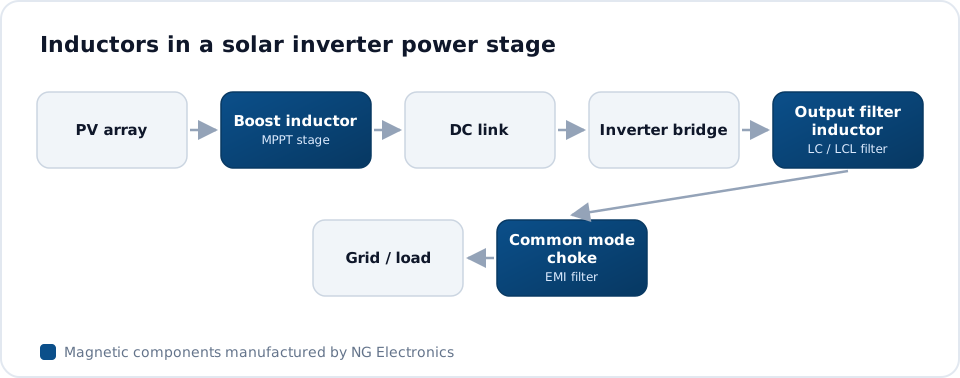
A typical inverter uses wound components at several points between the PV input and the AC output.
The boost inductor for solar inverter input stages raises the array voltage to the DC link level. It needs stable inductance at peak current and low loss at the switching frequency.
Enquire now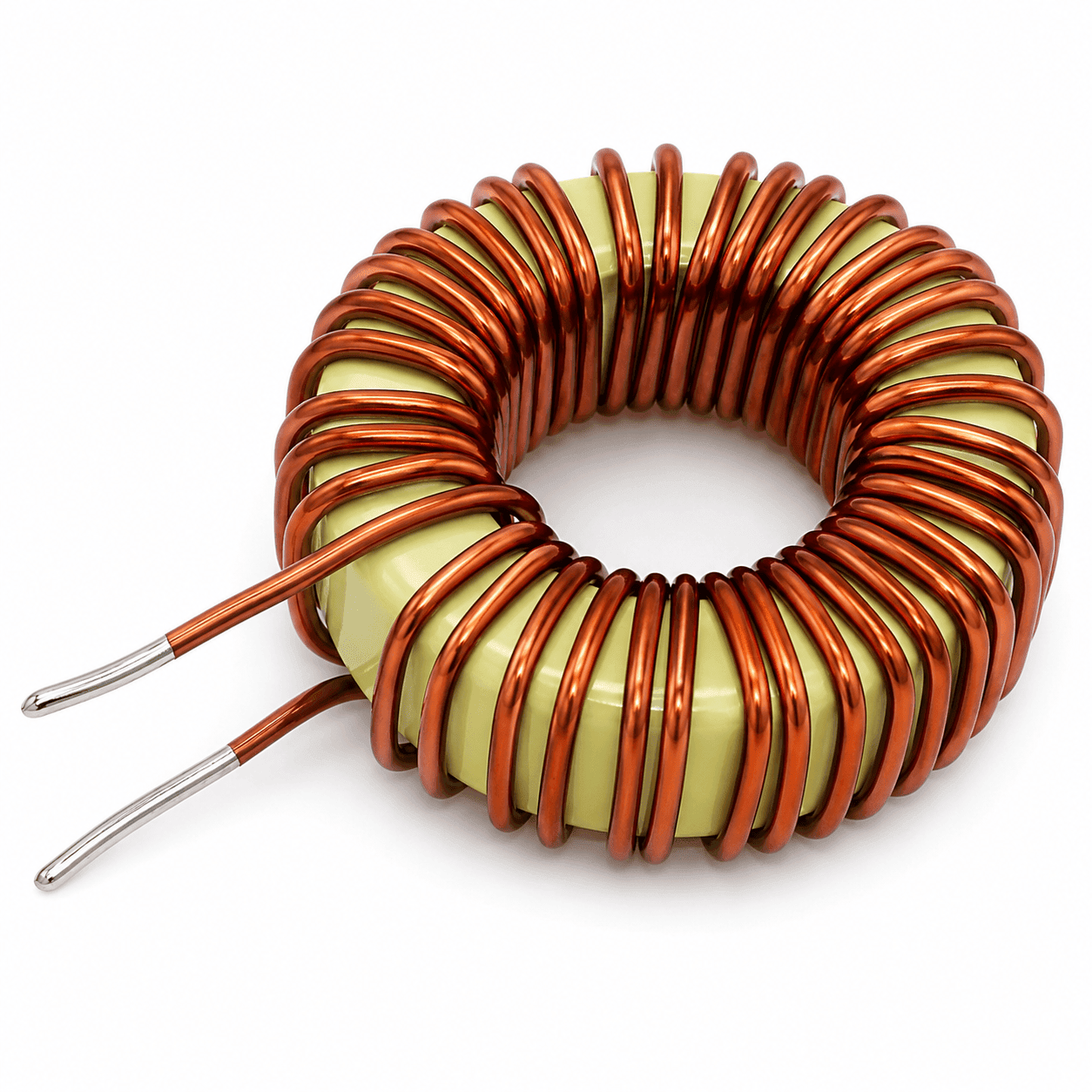
After the bridge, the filter inductor and capacitor remove switching ripple from the sine wave. Core choice balances the line-frequency flux against high-frequency loss.
Enquire now
Bidirectional converters between battery and DC link use an inductor that carries current in both directions, so it is rated on the worst-case charge or discharge level.
Enquire now
Common mode chokes on the DC input and AC output help the inverter meet conducted emission limits. We make these as well, in ring-core types up to 50 A.
Enquire nowStock parts you can order today. View details, add to cart or enquire for a custom variant.

Send the stage, inductance, peak current and switching frequency to sales@ngelectronics.in or WhatsApp +91 83290 52861. We respond with a technical quotation within 24 working hours.
Iron powder is the economical starting point and works well where ripple is modest and frequency is moderate. Its drawbacks are comparatively high core loss as frequency rises and, in grades with an organic binder, a gradual loss increase if the core is held at high temperature for years. That second point deserves attention in a product expected to run outdoors for a long service life, and it argues for a conservative temperature rise.
Sendust has noticeably lower loss than iron powder and is widely used for boost inductors where efficiency matters. High Flux typically keeps more of its inductance under heavy DC bias, which allows a smaller core for the same peak current, though it costs more. We supply both through our custom wound range and can quote alternatives side by side when the choice is not obvious from the specification.


Solar inverters are among the industries NG Electronics serves from Pune, where the company was founded in 2017. Winding, finishing and testing all happen at our Chimbli facility, using semi-automatic toroidal winding machines, LCR testers and single and three phase power analysers. Keeping the work in one place lets us hold a design steady from the first sample through to repeat production lots.
The company is ISO 9001:2015 certified, and batch records link each lot to its raw material and production date, which helps when a field return has to be investigated. You receive a technical quotation within 24 working hours of sharing a specification, a free sample for lab approval, and a test certificate with the order on request. We ship across India and welcome enquiries from overseas inverter builders.
Call, WhatsApp or use the form with inductance, current and quantity.
Price, lead time and datasheet within 24 working hours.
Sample built in-house for your lab testing and approval.
Production with 100% electrical testing under ISO 9001:2015.
Packed with a test certificate, shipped across India or exported worldwide.
Answers about toroidal inductor for solar inverter from NG Electronics, an ISO 9001:2015 certified company
There is no single answer. Iron powder is economical and adequate at moderate frequency and ripple. Sendust gives lower core loss and is a common choice for efficient boost stages. High Flux typically retains more inductance at high DC bias, allowing a smaller part. We compare options against your current, frequency and temperature limits.
We need the input voltage range, DC link voltage, maximum power, switching frequency, target ripple current or inductance, and peak and RMS inductor current. Ambient temperature, cooling arrangement and any size or mounting limits complete the picture. If you only have the electrical operating points, our engineers can propose the inductance and core; design support is free against firm production intent.
A boost inductor carries DC with high-frequency ripple, so DC bias behaviour and switching-frequency core loss dominate. An output filter inductor carries the 50 Hz sine current with ripple from the bridge superimposed, so the core sees a large low-frequency flux swing and must not saturate at the peak of the sine wave, including overloads.
Yes. The 25 A figure is the limit of our standard toroidal power inductor range. Custom designs go higher using heavier gauge or multi-strand copper and a correspondingly larger core. The practical ceiling depends on inductance, allowable temperature rise and the space available, so we state the achievable rating in the quotation after reviewing your specification.
Long life comes mainly from running cool. We size the winding and core to the temperature rise you specify at your maximum ambient, and advise on core material where sustained heat could raise losses over time. Every unit is tested for inductance, DCR, Q factor, saturation current and hipot, and batch records provide traceability. Enclosure-level validation remains the inverter maker's responsibility.
Custom samples are typically ready within 7 to 10 working days and are provided free for lab approval. Single-piece prototypes are possible for custom designs, and about 10 pieces is a normal quantity for R&D builds. Production minimums for custom parts are typically 100 to 1,000 pieces. Orders are delivered with a test certificate on request.
Standard range 10 µH to 10 mH, up to 25 A.
Learn moreHigh current toroidal inductor manufacturer in Pune, ISO 9001:2015 certified
Learn more
Built to your inductance, current and footprint.
Learn moreEMI suppression chokes from 250 mA to 50 A.
Learn moreSend your specification or drawing for toroidal inductor for solar inverter. NG Electronics is an ISO 9001:2015 certified company, and every enquiry is answered by our engineering and sales team in Pune.



These products are limited, checkout within

Smart configuration workspace setup.


